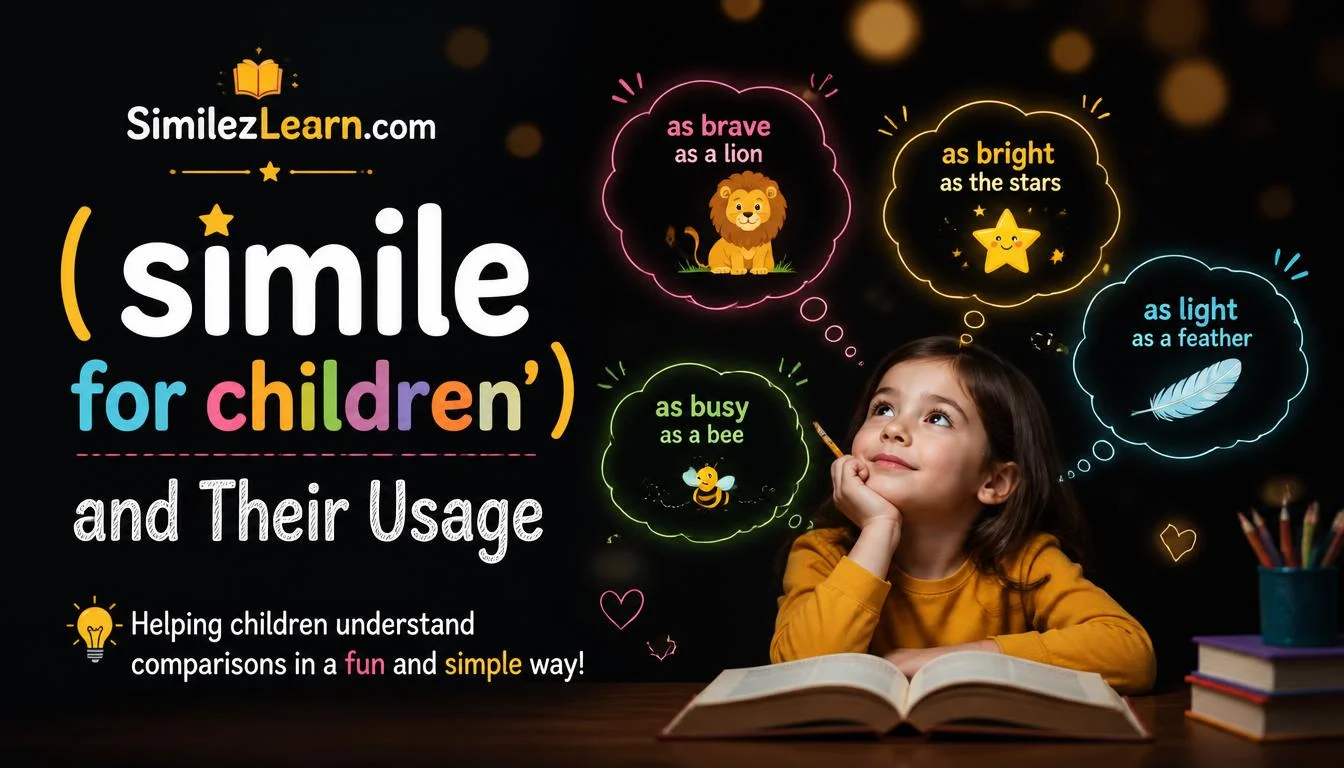
Children learn English more easily when lessons are fun, colorful, and easy to understand. One of the best ways to make language exciting is by using similes. A simile for children compares two different things using the words “like” or “as” to help young learners imagine ideas more clearly.
For example, instead of saying, “The rabbit is fast,” you can say, “The rabbit is as fast as the wind.” This simple comparison creates a picture in a child’s mind and makes learning more enjoyable.
In everyday conversations, people often use similes for children in stories, poems, classroom activities, and daily conversations. These creative expressions improve vocabulary, reading comprehension, and writing skills.
Updated for 2026, this guide explains similes in simple English with easy examples, meanings, and practical uses for students, teachers, parents, and young writers.
What Is a Simile for Children?
A simile for children is a simple comparison between two different things using the words “like” or “as.” It helps children understand ideas by comparing something unfamiliar with something they already know.
For example:
- The baby slept like an angel.
- The ice was as cold as snow.
These comparisons make sentences more interesting and easier to imagine.
Why Are Similes Important for Children?
Similes help children:
- Improve vocabulary.
- Understand stories more easily.
- Write creative essays and poems.
- Describe people, places, and things clearly.
- Build confidence in speaking and writing.
From real-life writing experience, children remember descriptive language better when they learn through simple and familiar comparisons.
How a Simile for Children Works
A simile compares two different things that share the same quality.
It always uses the words “like” or “as.”
Simple Formula
Subject + like/as + comparison
Examples:
- The kitten is as soft as cotton.
- He runs like the wind.
These comparisons describe softness and speed in an easy-to-understand way.
How Similes Are Used in Everyday Life
Children hear similes in many places, including:
- School lessons
- Storybooks
- Fairy tales
- Poems
- Cartoons
- Family conversations
In everyday conversations, people often use similes for children because they make descriptions more colorful and memorable.
Simile for Children in Writing
Using Similes in Essays
Similes make essays more descriptive.
Simple sentence:
The flower is beautiful.
Creative sentence:
The flower is as beautiful as a rainbow.
Using Similes in Stories
Stories become more exciting when writers use comparisons.
Example:
The little bird flew like an airplane across the sky.
Using Similes in Poems
Poets use similes to help readers imagine scenes and feelings.
Example:
Her smile was as bright as the sun.
Using Similes in Daily Conversations
Children naturally use similes while talking.
Examples:
- I am as hungry as a bear.
- My brother is as funny as a clown.
- The baby is as quiet as a mouse.
50 Simile for Children Examples
1. As Busy as a Bee
Meaning: Very active or hardworking.
Example: Emma was as busy as a bee while making her art project.
2. As Brave as a Lion
Meaning: Very courageous.
Example: The little boy was as brave as a lion during the school play.
3. As Quiet as a Mouse
Meaning: Very silent.
Example: The children were as quiet as a mouse during the reading lesson.
4. As Fast as the Wind
Meaning: Very fast.
Example: The runner was as fast as the wind in the race.
5. As Happy as a Clam
Meaning: Very happy.
Example: Lily was as happy as a clam after winning the drawing competition.
6. As Soft as Cotton
Meaning: Very soft.
Example: The teddy bear felt as soft as cotton.
7. As Bright as the Sun
Meaning: Very cheerful or intelligent.
Example: Her smile was as bright as the sun.
8. As Strong as an Ox
Meaning: Very strong.
Example: The superhero was as strong as an ox.
9. As Sweet as Honey
Meaning: Very kind or pleasant.
Example: Grandma is as sweet as honey to everyone.
10. As Light as a Feather
Meaning: Very light.
Example: The balloon was as light as a feather.
11. As Cool as Ice
Meaning: Very calm.
Example: Mia stayed as cool as ice during the quiz.
12. As White as Snow
Meaning: Pure white.
Example: The rabbit was as white as snow.
13. As Gentle as a Lamb
Meaning: Very kind and gentle.
Example: The teacher was as gentle as a lamb with the new students.
14. As Clever as a Fox
Meaning: Very intelligent.
Example: Jack was as clever as a fox when solving the puzzle.
15. As Hungry as a Wolf
Meaning: Extremely hungry.
Example: After playing outside all afternoon, the children were as hungry as a wolf.
16. As Playful as a Puppy
Meaning: Very playful and energetic.
Example: The little boy was as playful as a puppy during recess.
17. As Busy as an Ant
Meaning: Very hardworking.
Example: The students were as busy as ants while decorating the classroom.
18. As Free as a Bird
Meaning: Feeling happy and free.
Example: The children felt as free as birds during the summer holidays.
19. As Shiny as a Star
Meaning: Very bright.
Example: Her new shoes were as shiny as a star.
20. As Slow as a Snail
Meaning: Very slow.
Example: The turtle moved as slow as a snail across the garden.
21. As Busy as a Squirrel
Meaning: Always active.
Example: Ben was as busy as a squirrel collecting leaves for his project.
22. As Warm as Sunshine
Meaning: Pleasantly warm.
Example: Mom’s hug was as warm as sunshine.
23. As Tall as a Giraffe
Meaning: Very tall.
Example: Tom looked as tall as a giraffe beside his younger brother.
24. As Tiny as an Ant
Meaning: Very small.
Example: The baby kitten was as tiny as an ant.
25. As Round as a Ball
Meaning: Perfectly round.
Example: The orange was as round as a ball.
26. As Busy as a Honeybee
Meaning: Extremely active.
Example: Lucy was as busy as a honeybee helping her teacher.
27. As Colorful as a Rainbow
Meaning: Full of bright colors.
Example: The drawing was as colorful as a rainbow.
28. As Quiet as the Night
Meaning: Completely silent.
Example: The classroom became as quiet as the night during the test.
29. As Fresh as a Daisy
Meaning: Full of energy and freshness.
Example: Emma looked as fresh as a daisy in the morning.
30. As Smooth as Silk
Meaning: Very smooth.
Example: The ribbon felt as smooth as silk.
31. As Quick as Lightning
Meaning: Extremely fast.
Example: Noah answered the question as quick as lightning.
32. As Cute as a Kitten
Meaning: Very adorable.
Example: The little baby was as cute as a kitten.
33. As Calm as the Sea
Meaning: Very peaceful.
Example: Sophie remained as calm as the sea before her performance.
34. As Loud as Thunder
Meaning: Very loud.
Example: The drum sounded as loud as thunder.
35. As Green as Grass
Meaning: Bright green.
Example: The playground was as green as grass after the rain.
36. As Sweet as Sugar
Meaning: Very kind or sweet.
Example: The little girl was as sweet as sugar to everyone she met.
37. As Bright as a Diamond
Meaning: Very bright or intelligent.
Example: Ethan’s idea was as bright as a diamond.
38. As Gentle as a Feather
Meaning: Very soft and careful.
Example: Dad lifted the sleeping baby as gentle as a feather.
39. As Strong as a Bear
Meaning: Very powerful.
Example: The young athlete was as strong as a bear.
40. As Busy as a School Teacher
Meaning: Very occupied.
Example: Mrs. Brown was as busy as a school teacher before the school event.
41. As Light as Air
Meaning: Very light.
Example: The scarf was as light as air.
42. As Cheerful as Spring
Meaning: Full of happiness.
Example: Ava was as cheerful as spring during the picnic.
43. As Gentle as Rain
Meaning: Soft and peaceful.
Example: His voice was as gentle as rain.
44. As Sharp as a Needle
Meaning: Very intelligent or quick-minded.
Example: Olivia was as sharp as a needle during the quiz competition.
45. As Busy as a Little Elf
Meaning: Constantly working or helping.
Example: The children were as busy as little elves making holiday decorations.
46. As Happy as the Morning Sun
Meaning: Extremely joyful.
Example: Leo was as happy as the morning sun on his birthday.
47. As Soft as a Cloud
Meaning: Very soft and comfortable.
Example: The pillow felt as soft as a cloud.
48. As Bright as a Rainbow
Meaning: Very colorful and cheerful.
Example: Her painting was as bright as a rainbow.
49. As Gentle as a Butterfly
Meaning: Very delicate and kind.
Example: The little girl touched the flower as gentle as a butterfly.
50. As Happy as a Child at a Birthday Party
Meaning: Extremely happy and excited.
Example: The winners were as happy as children at a birthday party after receiving their prizes.
Famous and Popular Similes for Children
Children’s books, poems, nursery rhymes, and classroom lessons often use similes because they make learning fun and easy to understand. These well-known comparisons help children imagine people, animals, and objects more clearly while improving their vocabulary.
As Busy as a Bee
Meaning: Very hardworking or always active.
Example: During the school fair, the children were as busy as bees decorating their classroom.
As Quiet as a Mouse
Meaning: Very silent.
Example: The class became as quiet as a mouse when the teacher began reading a story.
As Brave as a Lion
Meaning: Very courageous.
Example: The little girl was as brave as a lion when she spoke in front of the whole class.
As Fast as Lightning
Meaning: Extremely fast.
Example: Ryan ran as fast as lightning to catch the school bus.
As Gentle as a Lamb
Meaning: Kind, calm, and caring.
Example: The nurse was as gentle as a lamb while helping the young child.
Simile for Children vs Other Figurative Language
Children often confuse similes with other figures of speech. Understanding the differences helps them use each one correctly.
| Figure of Speech | Meaning | Example |
|---|---|---|
| Simile | Compares two things using like or as | She is as bright as the sun. |
| Metaphor | Makes a direct comparison | She is a shining star. |
| Personification | Gives human qualities to objects or animals | The wind whispered through the trees. |
| Hyperbole | Uses exaggeration for emphasis | I have told you a million times. |
How to Identify a Simile
A sentence is usually a simile if it contains the words like or as to compare two different things.
Example:
- The baby slept like an angel.
- The snow was as white as cotton.
How to Create a Simile for Children
Writing similes is easy when children follow a few simple steps.
Step 1: Choose What You Want to Describe
Think about something such as:
- A person
- An animal
- A toy
- A feeling
- A place
- A favorite object
Step 2: Think About Its Best Quality
Ask yourself:
- Is it fast?
- Is it soft?
- Is it bright?
- Is it loud?
- Is it kind?
- Is it happy?
Step 3: Find Something With the Same Quality
Choose something children already know.
For example:
- Fast → Lightning
- Soft → Cotton
- Bright → Sun
- Quiet → Mouse
- Brave → Lion
- Busy → Bee
Step 4: Use “Like” or “As”
Now create your own simile.
Examples:
- The rabbit is as quick as lightning.
- Her smile is like sunshine.
- The pillow is as soft as a cloud.
From real-life writing experience, children learn similes much faster when they create their own examples instead of memorizing them.
Where Children Can Use Similes
Similes are useful in many everyday situations.
School Essays
Similes make essays more descriptive and enjoyable to read.
Simple: The tree was tall.
Better: The tree was as tall as a tower.
Story Writing
Stories become more exciting with creative comparisons.
Example:
The dragon was as fierce as a storm.
Poems
Poets use similes to create beautiful pictures with words.
Example:
The stars twinkled like tiny diamonds.
Daily Conversations
In everyday conversations, people often use similes for children to describe feelings, people, and experiences in a fun way.
Examples include:
- I’m as hungry as a wolf.
- She’s as happy as a lark.
- He’s as cool as a cucumber.
Social Media Captions
Even simple captions become more creative with similes.
Examples:
- Shine like the sun.
- Smile like a rainbow after rain.
- Dream as high as the clouds.
Tips for Learning Similes Easily
Read Storybooks
Children’s books contain many simple similes that are easy to understand.
Practice Every Day
Try writing one new simile each day about a person, place, or object.
Observe Nature
Nature provides wonderful ideas for comparisons.
For example:
- As blue as the sky
- As green as the grass
- As bright as the stars
Common Mistakes Children Make When Using Similes
Learning similes is fun, but children sometimes make simple mistakes. Understanding these common errors helps them write clearer and more meaningful comparisons.
Using “Like” or “As” Incorrectly
A simile must use like or as to compare two different things.
Incorrect: The rabbit is a rocket.
Correct: The rabbit is as fast as a rocket.
Choosing Comparisons That Do Not Match
A good simile compares things that share the same quality.
Incorrect: The ice cream was as loud as a flower.
This comparison does not make sense because flowers are not loud.
Correct: The ice cream was as sweet as honey.
Making Similes Too Difficult
Young learners should use simple and familiar comparisons.
Difficult: The cloud was like a mysterious object from another galaxy.
Better: The cloud was as soft as cotton.
Simple similes are easier for readers to understand and remember.
Using Too Many Similes in One Paragraph
Adding a simile to every sentence can make writing feel repetitive.
Instead, choose one or two strong comparisons that make your writing more interesting.
Forgetting the Meaning of the Simile
Children should understand what a simile means before using it.
Example: The baby was as quiet as a mouse.
This means the baby was very quiet, not that the baby was actually a mouse.
Benefits of Learning Similes for Children
Similes are more than just fun expressions. They help children become confident readers, writers, and speakers.
Improves Vocabulary
Children learn new words and discover creative ways to describe people, places, and things.
Develops Creative Writing
Stories, essays, and poems become more interesting when similes are used naturally.
Example:
Simple: The river was beautiful.
Creative: The river was as clear as crystal.
Builds Reading Skills
Many storybooks use similes. Understanding them helps children enjoy reading and understand stories more easily.
Boosts Speaking Confidence
Children who use descriptive language often express their ideas more clearly during classroom discussions and presentations.
Makes Learning Fun
Creative comparisons encourage children to use their imagination while learning English.
From real-life writing experience, students remember similes better when they use them in their own stories and classroom activities.
Frequently Asked Questions
What is a simile for children?
A simile is a comparison between two different things using like or as.
Example: The puppy is as playful as a monkey.
Why should children learn similes?
Similes improve vocabulary, reading, writing, creativity, and communication skills. They also make learning English more enjoyable.
What words are used in a simile?
The words like and as are commonly used to create similes.
Example: The snow is as white as milk.
Where can children use similes?
Children can use similes in:
- School essays
- Stories
- Poems
- Speeches
- Classroom activities
- Daily conversations
- Social media captions
How can children create their own similes?
Choose something to describe, think about its main quality, and compare it with something familiar using like or as.
Example:
Quality: Bright
Simile: The star is as bright as a diamond.
Related Topics You May Also Like
If you enjoyed learning about similes for children, you may also like these topics:
- Simile Examples for Students
- Easy Metaphor Examples
- Personification Examples for Kids
- Hyperbole Examples for Children
- Idioms With Meanings
- Figurative Language Examples
- Similes and Metaphors Worksheets
Conclusion
A simile for children is one of the easiest and most enjoyable ways to learn descriptive English. By comparing two different things with like or as, children can make their writing, speaking, and reading more colorful and engaging.
In everyday conversations, people often use similes for children to explain ideas in a simple and memorable way. Whether writing an essay, creating a poem, telling a story, or speaking in class, similes help children express themselves with confidence.
Updated for 2026, this guide included simple explanations, practical tips, and 50 easy simile examples with meanings and sentences. Keep practicing by creating your own similes every day, and you’ll soon become a more creative and confident English learner.
DISCOVER MORE ARTICLE
Creative Simile Metaphor Examples for Students Today 202
Simile for Fish Swimming: 50 Creative Examples Explained 2026
A Simile for Smart: Complete Guide for Writers 2026
