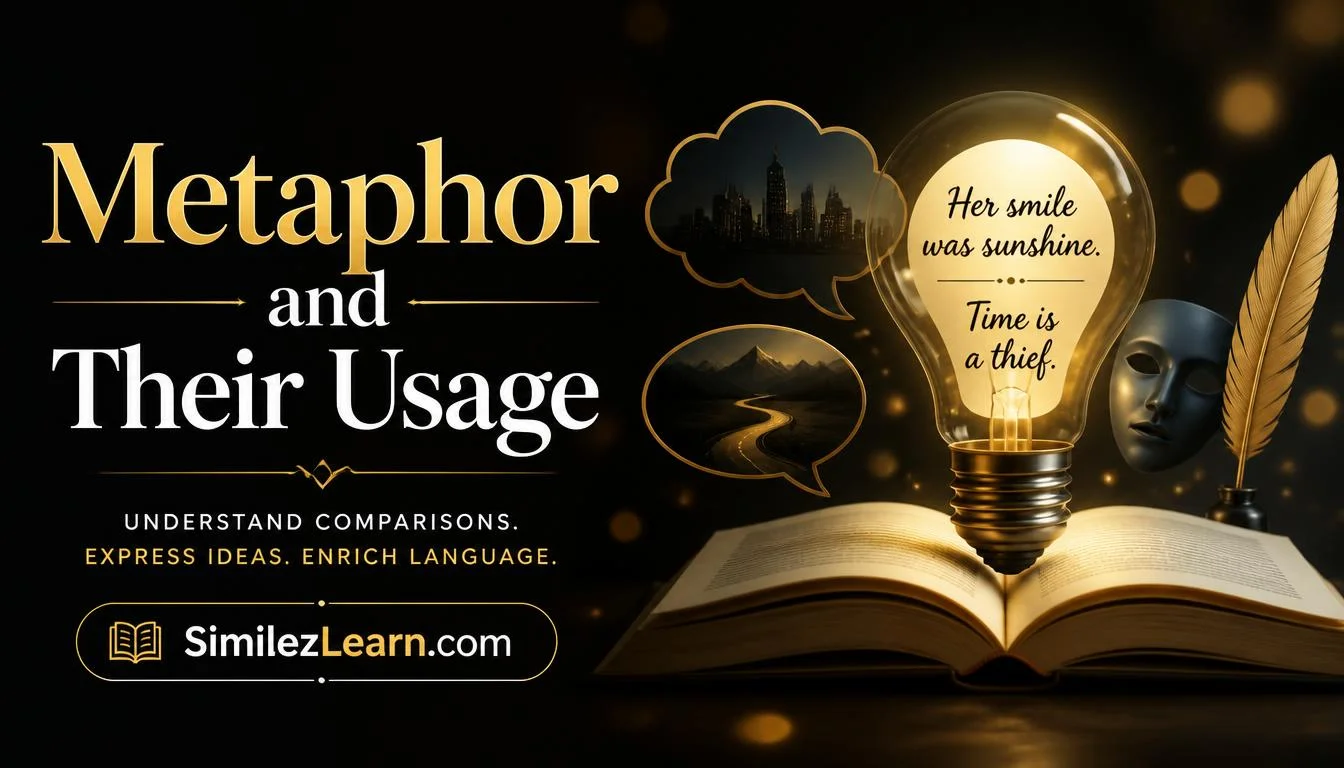
A metaphor picture turns an abstract idea into something you can see. Instead of simply saying that someone is brave, for example, a picture might show a small person standing like a mountain against a storm. The image does not literally mean the person is a mountain; it visually represents strength, courage, and determination.
This makes metaphor pictures especially useful for students, teachers, writers, artists, designers, and social media creators. A well-designed image can communicate an idea within seconds while adding emotion and creativity.
In everyday conversations, people often use metaphors to explain feelings and experiences. A metaphor picture takes that same creative comparison and gives it a visual form. This guide, updated for 2026, explains what metaphor pictures are, how they work, and how you can create your own.
What Is a Metaphor Picture?
A metaphor picture is an image that represents one idea through another image or object. It communicates a comparison without necessarily showing the literal meaning.
For example:
“Her smile is sunshine.”
A literal picture would show a person smiling. A metaphor picture could show a smiling person surrounded by warm sunlight, suggesting that her smile brings happiness and warmth.
The picture uses one visual idea to communicate another.
Simple Definition
In simple words, a metaphor picture is:
A visual representation that compares one thing to another to express an idea, feeling, or quality.
The comparison is usually imaginative rather than literal.
Why Are Metaphor Pictures Useful?
Metaphor pictures can make complicated ideas easier to understand.
They are useful for:
- English and literature lessons
- Creative writing
- Poetry
- School presentations
- Classroom activities
- Posters
- Blog illustrations
- Social media posts
- Advertising and branding
- Personal projects
- Visual storytelling
A strong image can make an abstract word such as freedom, fear, hope, loneliness, success, or love easier to visualize.
How Does a Metaphor Picture Work?
A metaphor picture works by connecting a familiar visual object with a different idea.
Think of it as a three-step process:
- Identify the idea.
- Find something that represents it.
- Combine the two visually.
For example, suppose the idea is stress.
You could represent stress as:
“Stress is a heavy backpack.”
A metaphor picture might show a person walking with an enormous backpack filled with clocks, books, phones, and paperwork.
The backpack represents the emotional and mental weight of stress.
Literal Picture vs. Metaphor Picture
A literal picture shows exactly what something is.
A metaphor picture shows what something feels like, means, or represents.
For example:
- Literal: A person sitting alone.
- Metaphorical: A person sitting inside a tiny island surrounded by a huge ocean.
- Meaning: The image represents loneliness or isolation.
This difference is important when learning visual metaphors.
40 Metaphor Picture Examples and Their Meanings
The following metaphor picture ideas can help students, writers, teachers, and content creators understand how visual metaphors work.
1. Life Is a Journey
Picture idea: A person walking along a winding road toward distant mountains.
Meaning: The road represents life’s experiences, choices, challenges, and destinations.
2. Time Is a River
Picture idea: A river flowing continuously toward the horizon.
Meaning: The flowing water represents how time moves forward and cannot be stopped.
3. Knowledge Is Light
Picture idea: A light bulb illuminating a dark room filled with books.
Meaning: Light represents knowledge because learning can remove confusion and ignorance.
4. Hope Is a Candle
Picture idea: A single candle glowing in a completely dark room.
Meaning: The small flame represents hope during difficult circumstances.
5. Love Is a Garden
Picture idea: Two people caring for a growing garden.
Meaning: The garden represents love because relationships need care, patience, and attention.
6. Anger Is a Volcano
Picture idea: A volcano about to erupt beside an angry-looking person.
Meaning: The volcano represents powerful emotions that can build up before exploding.
7. Dreams Are Wings
Picture idea: A person with wings flying above the clouds.
Meaning: Wings represent dreams because ambitions can help people rise beyond limitations.
8. Fear Is a Shadow
Picture idea: A person walking while an enormous shadow follows behind.
Meaning: The shadow represents fear that continues to follow someone.
9. Success Is a Mountain
Picture idea: A climber reaching the top of a tall mountain.
Meaning: The mountain represents a difficult goal that requires effort and persistence.
10. Failure Is a Stepping Stone
Picture idea: A person crossing a river by stepping on stones labeled with mistakes.
Meaning: The stones show how mistakes can become opportunities for growth.
11. Friendship Is a Bridge
Picture idea: Two people standing on opposite sides of a strong bridge.
Meaning: The bridge represents friendship because it connects people.
12. Memory Is a Photograph
Picture idea: Old photographs floating through someone’s mind.
Meaning: Photographs represent memories preserved from the past.
13. Happiness Is Sunshine
Picture idea: A person surrounded by bright sunlight after walking through dark clouds.
Meaning: Sunshine represents happiness, warmth, and positive emotions.
14. Sadness Is a Rain Cloud
Picture idea: A small rain cloud following a person.
Meaning: The cloud represents sadness that seems to remain overhead.
15. Words Are Seeds
Picture idea: Written words growing into flowers.
Meaning: Words can create ideas, emotions, and changes just as seeds produce plants.
16. Education Is a Key
Picture idea: A student holding a key that opens a large door.
Meaning: The key represents education as something that can open new opportunities.
17. Opportunity Is an Open Door
Picture idea: A person standing before a bright open doorway.
Meaning: The door represents a new possibility or chance.
18. Problems Are Puzzles
Picture idea: Someone assembling a huge puzzle.
Meaning: The puzzle represents challenges that require patience and problem-solving.
19. Patience Is a Tree
Picture idea: A person waiting beneath a tree while it grows from a seed.
Meaning: The growing tree represents the rewards that can come from patience.
20. Creativity Is a Spark
Picture idea: A tiny spark turning into colorful ideas and drawings.
Meaning: The spark represents the beginning of a creative thought.
21. The Mind Is an Ocean
Picture idea: A person diving into an enormous ocean filled with books and ideas.
Meaning: The ocean represents the depth and complexity of the human mind.
22. A Busy Life Is a Race
Picture idea: A person running along a track surrounded by clocks and phones.
Meaning: The race represents a fast-paced lifestyle.
23. Stress Is a Heavy Backpack
Picture idea: A person struggling beneath an oversized backpack.
Meaning: The backpack represents the emotional burden created by stress and responsibilities.
24. Confidence Is a Crown
Picture idea: A person wearing a crown while standing confidently.
Meaning: The crown represents self-belief and personal strength.
25. Doubt Is a Fog
Picture idea: A person walking through thick fog without seeing the road ahead.
Meaning: Fog represents uncertainty and difficulty making decisions.
26. Wisdom Is an Old Tree
Picture idea: An ancient tree with books hanging from its branches.
Meaning: The tree represents knowledge and wisdom gained over time.
27. Change Is a Butterfly
Picture idea: A caterpillar transforming into a butterfly.
Meaning: The butterfly represents growth, transformation, and a new stage of life.
28. A Secret Is a Locked Box
Picture idea: A person holding a locked box with no key.
Meaning: The locked box represents information that is hidden from others.
29. Social Media Is a Megaphone
Picture idea: A smartphone connected to a giant megaphone.
Meaning: The megaphone represents how social media can amplify a person’s voice.
30. The Internet Is a Highway
Picture idea: Cars traveling on a highway made of digital symbols.
Meaning: The highway represents the rapid movement of information online.
31. Kindness Is a Boomerang
Picture idea: Someone giving another person a gift while a similar gift returns.
Meaning: The boomerang suggests that kindness can come back through positive actions and relationships.
32. Anger Is Fire
Picture idea: Flames growing around a person’s silhouette.
Meaning: Fire represents the intensity and destructive potential of uncontrolled anger.
33. Life Is a Book
Picture idea: A person opening a huge book whose pages contain different life scenes.
Meaning: The book represents experiences, chapters, changes, and personal growth.
34. A Goal Is a Target
Picture idea: An archer aiming at a distant target.
Meaning: The target represents a specific objective that requires focus.
35. Motivation Is Fuel
Picture idea: A vehicle moving forward with glowing fuel inside its tank.
Meaning: Fuel represents the energy and determination needed to keep going.
36. Grief Is a Storm
Picture idea: A person standing beneath dark clouds and heavy rain.
Meaning: The storm represents the overwhelming emotional experience of grief.
37. Peace Is Still Water
Picture idea: A calm lake reflecting mountains and clouds.
Meaning: Still water represents calmness, balance, and emotional peace.
38. A New Beginning Is Sunrise
Picture idea: A sunrise appearing behind a dark landscape.
Meaning: Sunrise represents a fresh start after a difficult period.
39. Competition Is a Battlefield
Picture idea: Two teams facing each other across a dramatic playing field.
Meaning: The battlefield represents intense competition, although the participants are not literally at war.
40. Imagination Is a Door
Picture idea: A child opening a door into a colorful fantasy world.
Meaning: The door represents access to creativity, possibilities, and imagined worlds.
Examples of Metaphor Pictures in Everyday Life
Metaphor pictures are not limited to English classrooms. You can see visual metaphors in modern communication, advertising, websites, posters, presentations, and social media.
For example, a light bulb is frequently used to represent an idea. A broken chain can represent freedom. A ladder can represent progress or career growth.
In everyday conversations, people often use phrases such as “I’m drowning in work” or “I’m carrying the weight of the world.” A designer can turn those expressions into visual metaphors.
In Social Media
A creator discussing personal growth might use a picture of a plant growing through concrete.
The image immediately communicates resilience without requiring a long explanation.
In Education
A teacher explaining learning might show a key opening a door.
The visual makes the abstract idea of educational opportunity easier for students to remember.
In Creative Writing
A poet might write:
“Her memories were locked rooms.”
A matching image could show a hallway filled with closed doors, representing memories that remain inaccessible or painful.
Famous or Popular Uses of Visual Metaphors
Visual metaphors are common in posters, editorial illustrations, advertising, book covers, educational materials, and digital design.
Popular symbolic images include:
- A light bulb for an idea
- A heart for love
- A broken chain for freedom
- A road for life’s journey
- A mountain for achievement
- A storm for emotional difficulty
- A sunrise for hope
- A bridge for connection
- A key for opportunity
- A seedling for growth
These images work because viewers already understand many of their cultural associations.
Metaphor Picture vs. Related Concepts
| Concept | Meaning | Example |
|---|---|---|
| Metaphor picture | Uses one visual idea to represent another | A mountain representing success |
| Literal picture | Shows something exactly as it is | A photograph of a mountain |
| Symbol | An image with an established meaning | A heart representing love |
| Simile | Makes a comparison using “like” or “as” | “Her smile is like sunshine” |
| Personification | Gives human qualities to something nonhuman | A smiling sun |
| Allegory | Uses an extended story or representation to express a larger idea | A journey representing personal growth |
A metaphor picture can sometimes include symbols, but the key feature is the creative comparison between two ideas.
How to Use or Create a Metaphor Picture
Creating your own metaphor picture does not require advanced artistic skills. The most important part is choosing a visual comparison that makes sense.
Step 1: Choose an Abstract Idea
Start with an idea that is difficult to photograph literally.
Examples include:
- Love
- Fear
- Freedom
- Success
- Hope
- Stress
- Friendship
- Creativity
- Confidence
Step 2: Brainstorm Visual Comparisons
Ask yourself:
“If this idea were an object, place, animal, weather condition, or journey, what would it be?”
For example:
Confidence → mountain
Fear → shadow
Hope → candle
Success → sunrise
Step 3: Build the Scene
Combine the abstract idea with the visual comparison.
For “success is a mountain,” you might create an image of a person climbing toward a bright summit.
Step 4: Keep the Message Clear
Avoid adding too many unrelated objects.
A good metaphor picture usually has a clear central idea that viewers can understand quickly.
Step 5: Add Text When Necessary
For educational graphics or social media posts, a short caption can strengthen the metaphor.
For example:
“Every challenge is another step toward the summit.”
The image and words then work together.
How Writers Can Use Metaphor Pictures
Writers can use visual metaphors as inspiration for essays, poems, stories, captions, and descriptive paragraphs.
Try choosing an abstract feeling and turning it into an image.
For example:
Loneliness is an empty train station.
This can inspire a paragraph describing silence, waiting, distance, and missed connections.
You can also use metaphor pictures to develop character descriptions.
Instead of writing:
“He was nervous.”
You could imagine:
“His thoughts were birds trapped inside a cage.”
That visual metaphor gives the reader a stronger emotional impression.
Common Mistakes People Make With Metaphor Pictures
1. Making the Image Too Literal
A metaphor picture should communicate an idea rather than simply show the object mentioned in the metaphor.
2. Using Too Many Symbols
Adding ten different symbols can make the image confusing.
Choose one strong central metaphor whenever possible.
3. Choosing an Unclear Comparison
The relationship between the image and the idea should be understandable.
A random object may look creative but fail to communicate the intended message.
4. Explaining Too Much
Sometimes the image can communicate the message on its own.
Avoid covering a powerful visual with unnecessary text.
5. Forgetting the Audience
A metaphor that works for literature students may not work equally well for young children or a business audience.
Choose imagery appropriate to your readers.
6. Confusing Metaphors With Similes
A simile normally uses “like” or “as.”
For example:
“Her voice is like music.”
A metaphor makes the comparison directly:
“Her voice is music.”
Both can inspire visual imagery, but they are different literary devices.
Practical Uses for Students and Teachers
Students can use metaphor pictures to improve their understanding of figurative language.
Teachers can ask students to:
- Choose a metaphor.
- Draw the metaphor literally and visually.
- Explain what the picture represents.
- Write a short paragraph about the comparison.
- Present the image to the class.
This activity combines visual learning, vocabulary, writing, and literary analysis.
Students can also create metaphor pictures for poetry projects or presentations.
Useful Internal Topics to Explore
If you are building a collection of figurative-language lessons, consider linking this topic to related subjects such as:
- What Is a Metaphor?
- Metaphor Examples
- Simile vs. Metaphor
- Types of Metaphors
- Personification Examples
- Extended Metaphor Examples
- Visual Metaphor Examples
These related topics can help readers move naturally from basic definitions to more advanced literary concepts.
Frequently Asked Questions About Metaphor Pictures
What is a metaphor picture?
A metaphor picture is an image that represents an idea through a creative visual comparison. For example, a mountain can represent success because reaching the top suggests achievement.
What is an example of a visual metaphor?
A light bulb representing an idea is a simple visual metaphor. The bulb does not literally mean “idea,” but its image communicates inspiration or discovery.
How do you make a metaphor picture?
Choose an abstract idea, find a strong visual comparison, and create an image that combines the two. Keep the central message simple and recognizable.
Can a photograph be a metaphor?
Yes. A photograph can function as a metaphor when its composition or subject represents a deeper idea. For example, a photograph of an open road can represent freedom or a new beginning.
Why are metaphor pictures useful for students?
They make abstract literary concepts easier to understand and remember. Creating a visual metaphor also encourages students to think creatively about language and meaning.
Conclusion
A metaphor picture gives an abstract idea a visual form. By showing concepts such as hope as a candle, success as a mountain, or knowledge as light, visual metaphors make language more memorable and emotionally powerful.
From real-life writing experience, one of the easiest ways to create a strong metaphor is to start with a feeling or idea and ask, “What could I see that would represent this?” That simple question can turn an ordinary sentence into an engaging visual concept.
Whether you are a student studying figurative language, a teacher creating classroom materials, a writer developing imagery, or a content creator designing a social post, practice turning words into pictures. The more you experiment with visual comparisons, the easier it becomes to understand and create effective metaphors.
DISCOVER MORE ARTICLES
Metaphors for Scared: 40 Creative Examples Explained 2026
Examples of Metaphors for Kids: 40 Easy Examples 2026
Anger Metaphors: 40 Creative Examples and Meanings 2026
