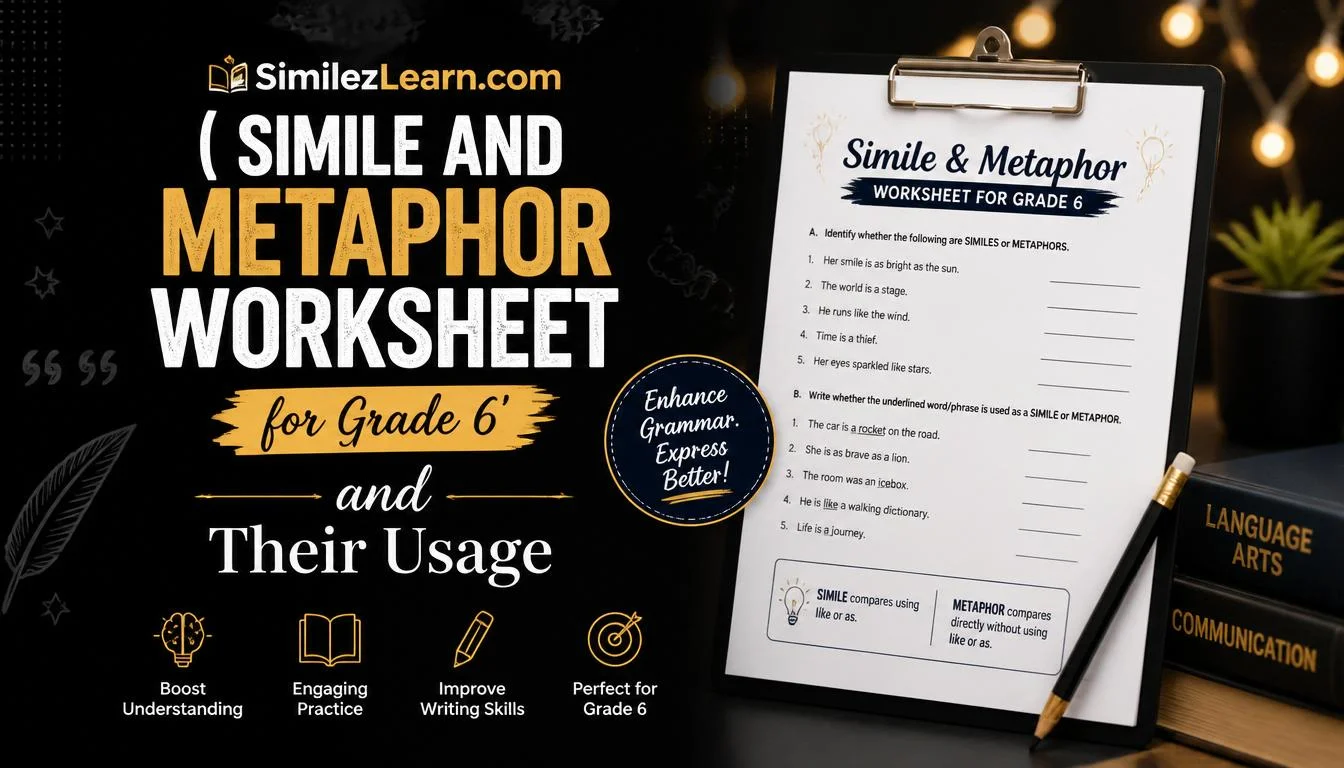
A simile and metaphor worksheet for Grade 6 helps students recognize, understand, and create these expressions through fun exercises. Whether you’re a student preparing for class, a teacher creating lessons, or a parent helping with homework, practicing these literary devices builds stronger reading and writing skills.
Updated for 2026, this guide includes simple explanations, real-life examples, and practical exercises designed especially for sixth-grade learners.
What Is a Simile and Metaphor Worksheet for Grade 6?
A simile and metaphor worksheet for Grade 6 is a practice sheet filled with activities that teach students how to identify, compare, and write similes and metaphors.
These worksheets usually include:
- Definitions
- Fill-in-the-blank exercises
- Matching activities
- Multiple-choice questions
- Sentence-writing practice
- Reading passages
- Creative writing tasks
The goal is to help students understand how figurative language makes writing more vivid and engaging.
How a Simile and Metaphor Worksheet for Grade 6 Works
Students first learn the difference between similes and metaphors.
Simile
A simile compares two different things using like or as.
Example:
She is as quiet as a mouse.
This means she is very quiet.
Metaphor
A metaphor compares two things without using like or as.
Example:
The classroom was a zoo.
This means the classroom was noisy and chaotic.
Most Grade 6 worksheets guide students from recognizing these expressions to writing their own.
Why Grade 6 Students Should Practice Similes and Metaphors
Learning figurative language helps students:
- Improve creative writing
- Understand novels and poems
- Write stronger essays
- Develop descriptive vocabulary
- Perform better in English exams
- Enjoy reading more
From real-life writing experience, students who regularly practice figurative language often become more confident writers because they learn to describe ideas in interesting ways.
Examples of Similes and Metaphors in Everyday Life
In everyday conversations, people often use similes and metaphors to explain feelings, experiences, and situations more clearly.
Examples include:
- “I’m as hungry as a bear.”
- “Life is a journey.”
- “He has a heart of gold.”
- “She’s as busy as a bee.”
These expressions appear in:
- School essays
- Story writing
- Poems
- Songs
- Movies
- Social media captions
- Daily conversations
Simile vs. Metaphor
| Feature | Simile | Metaphor |
|---|---|---|
| Comparison | Direct | Direct |
| Uses “like” or “as” | Yes | No |
| Example | Brave as a lion | He is a lion |
| Purpose | Describe clearly | Create stronger imagery |
Remember this simple rule:
Like or as = Simile
No like or as = Metaphor
How to Create Similes and Metaphors
Creating figurative language becomes easier with practice.
Step 1
Think about the thing you want to describe.
Step 2
Choose something with similar qualities.
Step 3
Decide whether to use a simile or metaphor.
Example:
Person: Very fast
Simile:
He runs like lightning.
Metaphor:
He is lightning on the track.
50 Simile and Metaphor Worksheet Practice Examples
1. As brave as a lion
Meaning: Very courageous.
Example: The firefighter was as brave as a lion during the rescue.
2. As busy as a bee
Meaning: Extremely hardworking.
Example: My mother is as busy as a bee every morning.
3. As light as a feather
Meaning: Very light.
Example: The balloon felt as light as a feather.
4. As cold as ice
Meaning: Extremely cold.
Example: The drink was as cold as ice.
5. As quiet as a mouse
Meaning: Very silent.
Example: Everyone stayed as quiet as a mouse during the test.
6. As slow as a snail
Meaning: Very slow.
Example: Traffic moved as slow as a snail.
7. As bright as the sun
Meaning: Very bright.
Example: Her smile was as bright as the sun.
8. As soft as cotton
Meaning: Extremely soft.
Example: The pillow felt as soft as cotton.
9. As strong as an ox
Meaning: Very strong.
Example: The worker was as strong as an ox.
10. As sweet as honey
Meaning: Very kind or sweet.
Example: My grandmother is as sweet as honey.
11. As fast as lightning
Meaning: Extremely fast.
Example: The athlete ran as fast as lightning.
12. As happy as a child at a playground
Meaning: Very joyful.
Example: She looked as happy as a child at a playground.
13. The classroom was a zoo.
Meaning: The classroom was noisy.
Example: Everyone talked at once, so the classroom was a zoo.
14. Time is money.
Meaning: Time is valuable.
Example: Successful people know time is money.
15. Her smile was sunshine.
Meaning: Her smile made everyone happy.
Example: Her smile was sunshine on a difficult day.
16. The world is a stage.
Meaning: Life is like a performance.
Example: Everyone has different roles because the world is a stage.
17. My brother is a rock.
Meaning: He is dependable.
Example: Whenever I need help, my brother is a rock.
18. Books are windows.
Meaning: Books help us explore new ideas.
Example: Books are windows into different cultures.
19. The test was a mountain.
Meaning: The test felt difficult.
Example: For many students, the test was a mountain to climb.
20. Her voice was music.
Meaning: Her voice sounded beautiful.
Example: Everyone smiled because her voice was music.
21. His mind is a computer.
Meaning: Very intelligent.
Example: He remembers every fact because his mind is a computer.
22. The stars were diamonds.
Meaning: The stars sparkled brightly.
Example: At night, the stars were diamonds in the sky.
23. The city never sleeps.
Meaning: The city is always active.
Example: Even after midnight, the city never sleeps.
24. Friendship is a bridge.
Meaning: Friendship connects people.
Example: Friendship is a bridge between different cultures.
25. His words were arrows.
Meaning: His words were hurtful.
Example: Everyone felt upset because his words were arrows.
26. As fresh as a daisy
Meaning: Feeling healthy and energetic.
Example: After a good night’s sleep, Emma felt as fresh as a daisy and ready for school.
27. As free as a bird
Meaning: Having complete freedom.
Example: During summer vacation, the children felt as free as a bird.
28. As cool as a cucumber
Meaning: Very calm in a stressful situation.
Example: Even before the big exam, Jack stayed as cool as a cucumber.
29. As clear as crystal
Meaning: Very easy to understand.
Example: The teacher’s explanation was as clear as crystal.
30. As gentle as a lamb
Meaning: Very kind and peaceful.
Example: The puppy was as gentle as a lamb with the baby.
31. As blind as a bat
Meaning: Unable to see well without help.
Example: Without his glasses, Tom is as blind as a bat.
32. As proud as a peacock
Meaning: Feeling extremely proud.
Example: Sarah looked as proud as a peacock after winning first prize.
33. As playful as a kitten
Meaning: Full of energy and fun.
Example: The little boy was as playful as a kitten all afternoon.
34. His heart is stone.
Meaning: He shows little kindness or sympathy.
Example: He refused to help anyone because his heart is stone.
35. My backpack is a mountain.
Meaning: The backpack is very heavy.
Example: After adding all my books, my backpack became a mountain.
36. The internet is a highway.
Meaning: Information travels quickly online.
Example: Today, the internet is a highway connecting people worldwide.
37. Her ideas are stars.
Meaning: Her ideas are brilliant.
Example: During the project discussion, her ideas were stars that inspired everyone.
38. The library is a treasure chest.
Meaning: The library contains valuable knowledge.
Example: For curious students, the library is a treasure chest.
39. His laughter was music.
Meaning: His laughter sounded joyful.
Example: Everyone smiled because his laughter was music.
40. The classroom was an oven.
Meaning: The room was extremely hot.
Example: Without fans, the classroom was an oven during the afternoon.
41. Her eyes were diamonds.
Meaning: Her eyes sparkled brightly.
Example: When she received the award, her eyes were diamonds.
42. The rain was a curtain.
Meaning: The rain fell heavily.
Example: Outside, the rain was a curtain covering the streets.
43. His brain is a sponge.
Meaning: He learns quickly.
Example: He remembers every lesson because his brain is a sponge.
44. The playground was an ocean of laughter.
Meaning: Many children were laughing happily.
Example: During recess, the playground became an ocean of laughter.
45. Dreams are wings.
Meaning: Dreams help people achieve success.
Example: Dreams are wings that encourage us to reach our goals.
46. Hope is a candle.
Meaning: Hope brings light during difficult times.
Example: Even during challenges, hope is a candle that keeps us moving forward.
47. Knowledge is power.
Meaning: Learning gives people strength and confidence.
Example: Every student should remember that knowledge is power.
48. Her smile was a rainbow.
Meaning: Her smile brought happiness.
Example: After hearing the good news, her smile was a rainbow.
49. His anger was a volcano.
Meaning: He became extremely angry.
Example: When he discovered the mistake, his anger was a volcano ready to erupt.
50. Kindness is a gift.
Meaning: Kindness is valuable and meaningful.
Example: Helping others reminds us that kindness is a gift everyone can share.
Famous Examples of Similes and Metaphors
Many famous writers use similes and metaphors to make their stories and poems memorable.
Some well-known examples include:
- “All the world’s a stage.” – A metaphor that compares life to a stage where everyone has different roles.
- “My love is like a red, red rose.” – A simile comparing love to a beautiful flower.
- “Life is a journey.” – A metaphor showing that life has many paths, challenges, and destinations.
- “As busy as a bee.” – A classic simile often used in everyday conversation.
- “Her smile shone like the sun.” – A simile that creates a bright and cheerful image.
Each example helps readers imagine ideas more clearly and makes writing more expressive.
How to Practice Using Similes and Metaphors
The best way to improve is through regular practice.
Try these simple activities:
- Read a short story and underline every simile and metaphor.
- Change ordinary sentences into descriptive ones.
- Write five similes about your favorite animal.
- Create five metaphors about school.
- Describe your best friend using figurative language.
- Keep a vocabulary notebook of interesting comparisons.
- Share your writing with classmates or family members for feedback.
From real-life writing experience, students who practice a little every week become much more confident in creative writing.
Common Mistakes People Make with Similes and Metaphors
Many Grade 6 students make small mistakes when learning figurative language.
1. Mixing Similes and Metaphors
Incorrect:
“He is like a lion.”
Calling this a metaphor is wrong because it uses like, making it a simile.
2. Taking Figurative Language Literally
“The classroom was a zoo.”
This does not mean animals were inside the classroom. It simply means the room was noisy.
3. Using Too Many Comparisons
Adding several similes and metaphors to every sentence can confuse readers.
Use them naturally instead.
4. Choosing Weak Comparisons
Good comparisons help readers easily understand your meaning.
Instead of writing random comparisons, choose ones that match the situation.
5. Forgetting the Purpose
Remember that similes and metaphors make writing more descriptive, not more complicated.
Where Can Students Use Similes and Metaphors?
These literary devices are useful in many kinds of writing, including:
- School essays
- Creative writing assignments
- Poems
- Stories
- Speech writing
- Reading comprehension
- Book reports
- Journal writing
- Social media captions
- Greeting cards
- Daily conversations
In everyday conversations, people often use similes and metaphors to explain emotions, describe experiences, and make stories more interesting.
Suggested Internal Links
To build a helpful learning resource, consider linking this article to:
- Simile Examples for Kids
- Metaphor Examples with Meanings
- Figurative Language Worksheets
- Idioms vs. Similes
- Personification Examples
- Hyperbole Examples
- Literary Devices for Students
- Types of Figurative Language
- Creative Writing Tips for Grade 6
- English Grammar Worksheets
Frequently Asked Questions (FAQs)
What is a simile and metaphor worksheet for Grade 6?
It is a practice worksheet that helps sixth-grade students identify, understand, and create similes and metaphors through fun English exercises.
What is the difference between a simile and a metaphor?
A simile uses like or as to compare two things, while a metaphor compares two things directly without using those words.
Why are similes and metaphors important?
They make writing more interesting, improve creativity, strengthen reading comprehension, and help students express ideas more clearly.
How can Grade 6 students improve their figurative language skills?
Students can read books, complete worksheets, practice writing descriptive sentences, and identify similes and metaphors in everyday conversations and stories.
Are similes and metaphors used outside the classroom?
Yes. They are commonly used in books, songs, movies, advertisements, speeches, social media captions, poems, and daily conversations.
Conclusion
A simile and metaphor worksheet for Grade 6 is an excellent learning tool for developing strong reading and writing skills. By practicing these figurative language techniques, students learn how to describe people, places, objects, and emotions in creative and memorable ways.
Whether you’re writing an essay, creating a poem, telling a story, or simply improving your English, similes and metaphors make your ideas more vivid and engaging. Keep practicing a few examples each week, and you’ll soon find that using figurative language becomes natural and enjoyable.
Updated for 2026, this guide provides everything Grade 6 students, parents, and teachers need to understand, practice, and confidently use similes and metaphors in everyday writing.
DISCOVER MORE ARTICLES
Simile for Something Rare: Learn with Easy Examples 2026
Simile for Pale Skin: 50+ Examples for Writing Skills 2026
Simile for Hard Worker: Simple Guide for Learners 2026
