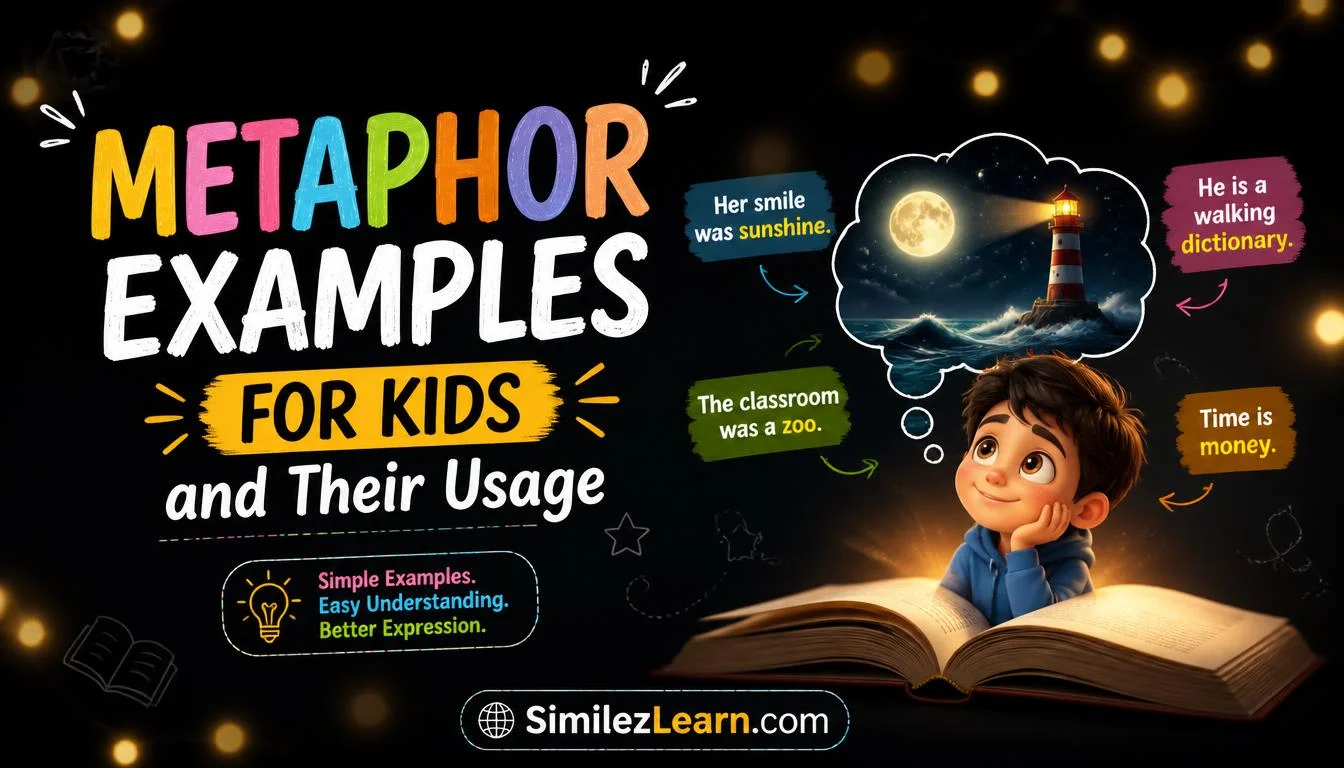
Learning figurative language does not have to feel difficult. Metaphor examples for kids can turn ordinary sentences into colorful, imaginative ideas that are easy to understand and remember.
A metaphor compares two different things by saying that one thing is another. For example, “The classroom was a zoo” does not mean there were real animals in the classroom. It means the classroom was noisy, busy, or difficult to control.
Kids hear and use metaphors every day—in conversations, cartoons, books, songs, stories, captions, and schoolwork. Once children learn to recognize these creative comparisons, they can also begin using them in their own writing.
This guide, updated for 2026, explains metaphors in simple language and provides 40 fun examples that children can use for homework, stories, poems, and creative activities.
What Are Metaphor Examples for Kids?
A metaphor is a figure of speech that says one thing is another thing to show a shared quality.
For example:
“My brother is a tornado.”
Your brother is not actually a tornado. The metaphor means he may be moving quickly, making a mess, or creating lots of activity.
Simple Definition of a Metaphor
A metaphor is:
A comparison that says one thing is another thing to help describe an idea in a creative way.
Metaphors are not meant to be taken literally.
Easy Metaphor Example
Consider:
“The moon is a silver coin.”
The moon is not really a coin. The writer compares it to a silver coin because it looks round, bright, and shiny.
That is what makes the sentence imaginative.
How Do Metaphors Work?
Metaphors work by connecting something familiar to something being described.
Children can use this simple formula:
Thing + is + creative comparison
For example:
The snow is a blanket.
The snow is not actually made of fabric. It is compared to a blanket because it covers the ground.
Why Do Writers Use Metaphors?
- Make descriptions more interesting
- Explain feelings
- Create strong pictures in the reader’s mind
- Make stories more imaginative
- Add personality to writing
- Make poems more memorable
In everyday conversations, people often use metaphors to describe feelings and experiences without even realizing it.
For example:
“I have butterflies in my stomach.”
This does not mean there are real butterflies inside someone. It describes the nervous feeling before something exciting.
40 Metaphor Examples for Kids
Here are 40 simple metaphor examples with meanings and short explanations.
1. The Classroom Was a Zoo
Meaning: The classroom was very noisy or chaotic.
Example: “After the exciting game, the classroom was a zoo.”
2. My Brother Is a Tornado
Meaning: He is energetic and may create a lot of activity.
Example: “My little brother is a tornado when he plays with his toys.”
3. The Snow Is a White Blanket
Meaning: Snow covers the ground like a blanket.
Example: “The snow was a white blanket across the garden.”
4. Her Smile Is Sunshine
Meaning: Her smile makes people feel happy and warm.
Example: “Her smile is sunshine on a cloudy day.”
5. The Moon Is a Silver Coin
Meaning: The moon looks round, bright, and silver.
Example: “Tonight, the moon looked like a silver coin in the sky.”
6. My Backpack Is a Brick
Meaning: The backpack feels very heavy.
Example: “My backpack is a brick after I pack all my books.”
7. The Baby Is a Little Angel
Meaning: The baby is sweet, gentle, or well-behaved.
Example: “Our baby sister is a little angel when she sleeps.”
8. The Wind Was a Whistling Ghost
Meaning: The wind made strange or spooky sounds.
Example: “The wind was a whistling ghost outside the window.”
9. His Voice Is Thunder
Meaning: His voice is very loud or powerful.
Example: “Dad’s voice was thunder when he called us inside.”
10. The Ocean Is a Blue Blanket
Meaning: The ocean looks like a huge blue covering.
Example: “From the airplane, the ocean looked like a blue blanket.”
11. My Dog Is a Rocket
Meaning: The dog runs extremely fast.
Example: “When I throw the ball, my dog is a rocket.”
12. The Sun Is a Golden Ball
Meaning: The sun looks round and golden.
Example: “The sun was a golden ball above the trees.”
13. Her Hair Is Silk
Meaning: Her hair is very smooth and soft.
Example: “Her hair was silk after she brushed it.”
14. The Stars Are Diamonds
Meaning: The stars look bright and sparkling.
Example: “The stars were diamonds scattered across the night sky.”
15. My Teacher Is a Walking Dictionary
Meaning: The teacher knows many words and meanings.
Example: “Ask Ms. Sara—she is a walking dictionary.”
16. The Baby’s Laugh Is Music
Meaning: The laugh sounds beautiful and pleasant.
Example: “The baby’s laugh is music to everyone’s ears.”
17. My Dad Is a Rock
Meaning: Dad is strong, dependable, or supportive.
Example: “Whenever I need help, my dad is a rock.”
18. The City Is a Jungle
Meaning: The city is busy, crowded, and complicated.
Example: “Finding my way through the huge city felt like entering a jungle.”
19. My Bed Is a Cloud
Meaning: The bed feels soft and comfortable.
Example: “After a long day, my bed was a cloud.”
20. The Homework Was a Mountain
Meaning: There was a huge amount of homework.
Example: “I had a mountain of homework last night.”
21. Her Eyes Are Stars
Meaning: Her eyes are bright or beautiful.
Example: “Her eyes were stars shining with excitement.”
22. The Test Was a Monster
Meaning: The test felt very difficult or frightening.
Example: “The math test was a monster, but I finished it.”
23. The Playground Was a Circus
Meaning: The playground was busy, noisy, and full of activity.
Example: “At lunchtime, the playground was a circus.”
24. My Friend Is a Sunshine Machine
Meaning: The friend constantly brings happiness and positive energy.
Example: “Ali is a sunshine machine who makes everyone laugh.”
25. The River Is a Silver Ribbon
Meaning: The river looks long, narrow, and shiny.
Example: “The river was a silver ribbon winding through the valley.”
26. My Pencil Is a Magic Wand
Meaning: The pencil helps the child create drawings, stories, or ideas.
Example: “When I write stories, my pencil becomes a magic wand.”
27. The Computer Is My Toolbox
Meaning: The computer provides many useful tools for completing tasks.
Example: “For school projects, my computer is my toolbox.”
28. Her Voice Is a Warm Blanket
Meaning: Her voice feels comforting and reassuring.
Example: “Grandma’s voice is a warm blanket when I feel worried.”
29. The Clouds Are Cotton Balls
Meaning: The clouds look soft and fluffy.
Example: “The clouds were cotton balls floating across the sky.”
30. My Little Sister Is a Butterfly
Meaning: She moves lightly, quickly, or happily.
Example: “My little sister is a butterfly as she dances around the garden.”
31. The Road Is a Snake
Meaning: The road twists and turns like a snake.
Example: “The road was a snake winding between the hills.”
32. His Words Were Arrows
Meaning: His words were hurtful.
Example: “His angry words were arrows that hurt my feelings.”
33. The Garden Is a Rainbow
Meaning: The garden contains many bright colors.
Example: “After the flowers bloomed, the garden became a rainbow.”
34. My Grandma Is a Treasure Chest
Meaning: Grandma has many valuable stories, memories, and experiences.
Example: “Grandma is a treasure chest full of wonderful stories.”
35. The Forest Is a Green Cathedral
Meaning: The forest feels large, peaceful, beautiful, and almost sacred.
Example: “The tall trees made the forest feel like a green cathedral.”
36. My Mind Is a Computer
Meaning: Someone’s mind is processing information quickly.
Example: “My sister’s mind is a computer when she solves puzzles.”
37. Fear Is a Monster
Meaning: Fear can feel powerful and frightening.
Example: “Before my first performance, fear was a monster inside me.”
38. Hope Is a Candle
Meaning: Hope provides light during difficult times.
Example: “Even on a difficult day, hope is a candle.”
39. Friendship Is a Bridge
Meaning: Friendship connects people.
Example: “Their friendship was a bridge between two different groups.”
40. Learning Is an Adventure
Meaning: Learning involves discovery, exploration, and new experiences.
Example: “Every new book makes learning an adventure.”
Metaphor Examples in Everyday Life
Children encounter metaphors outside the classroom all the time.
Parents might say:
“You are a star!”
This means the child has done something excellent.
A coach might say:
“Keep your eye on the ball.”
Depending on context, this can be literal or can encourage someone to stay focused.
A friend might say:
“That homework was a monster.”
The word monster describes how difficult or overwhelming the homework felt.
In everyday conversations, metaphors help people communicate feelings quickly and creatively.
Famous or Popular Metaphor Examples Kids May Know
Children can find metaphors in stories, poems, movies, advertisements, and popular expressions.
“You Are My Sunshine”
This familiar expression compares a person to sunshine.
It suggests that the person brings happiness, comfort, or warmth.
“The World Is Your Oyster”
This expression suggests that many opportunities are available.
The world is not literally an oyster; the metaphor creates an image of possibilities waiting to be discovered.
“Time Is a Thief”
This metaphor describes how time seems to take moments away from us.
It is especially useful when writing about growing up or memories.
“Books Are Windows”
Books can be compared to windows because they allow readers to see new worlds, experiences, and perspectives.
Metaphor vs. Simile for Kids
One of the most common mistakes children make is confusing metaphors with similes.
| Metaphor | Simile |
|---|---|
| Makes a direct comparison | Uses “like” or “as” |
| “The moon is a lamp.” | “The moon is like a lamp.” |
| “My brother is a tornado.” | “My brother is like a tornado.” |
| “Her smile is sunshine.” | “Her smile is like sunshine.” |
Both literary devices make comparisons, but their sentence structures are different.
Easy Trick to Remember
If you see like or as making a comparison, you probably have a simile.
If one thing is directly described as another, you probably have a metaphor.
Metaphor vs. Personification for Kids
Personification gives human qualities to nonhuman things.
For example:
“The wind whispered through the trees.”
The wind cannot literally whisper like a person, so the sentence uses personification.
A metaphor is different:
“The wind was a ghost.”
The wind is directly compared to a ghost.
How to Create Metaphors for Kids
Creating metaphors can become a fun creative-writing activity.
Step 1: Choose Something to Describe
Pick a person, place, object, feeling, or experience.
For example:
A school day
Step 2: Think of Its Qualities
Maybe the school day is:
- Busy
- Loud
- Long
- Exciting
- Tiring
Step 3: Find Something With Similar Qualities
If it is very busy, you might choose:
A race
Step 4: Write the Metaphor
“My school day is a race.”
Step 5: Explain It
The school day feels like a race because there are many classes, activities, and tasks to finish.
Fun Classroom Activities With Metaphors
Teachers and parents can make metaphor practice enjoyable.
Metaphor Drawing Game
Give children a metaphor such as:
“The sun is a golden ball.”
Ask them to draw what the sentence means.
Finish the Metaphor
Give students a sentence starter:
“My teacher is a ______.”
Students can choose:
- Lighthouse
- Book
- Star
- Coach
- Tree
Then they explain their choice.
Metaphor Hunt
Ask children to look through a story and find metaphors.
They can write each metaphor in one column and its meaning in another.
Create a Metaphor Poem
Ask students to choose one subject and create several metaphors.
For example:
My school is a garden.
My teacher is a gardener.
Books are seeds.
Ideas are flowers.
This activity helps children understand how metaphors can work together.
Common Mistakes Kids Make With Metaphors
1. Taking the Metaphor Literally
If a sentence says “My teacher is a walking dictionary,” it does not mean the teacher is actually a dictionary.
It means the teacher knows many words.
2. Confusing Metaphors With Similes
Remember that similes commonly use like or as, while metaphors make a direct comparison.
3. Choosing a Random Comparison
A metaphor should have a reason behind it.
“My pencil is a banana” does not communicate much unless there is a clear connection.
4. Forgetting to Explain the Meaning
When completing schoolwork, children should be able to explain what their metaphor means.
5. Making Metaphors Too Complicated
Young learners should begin with familiar objects such as:
- Stars
- Clouds
- Animals
- Books
- Roads
- Sunshine
- Mountains
- Flowers
Simple comparisons are often the easiest to understand.
How Writers Can Use Metaphors
Metaphors are useful beyond elementary school.
Young writers can use them in:
- Stories
- Poems
- Essays
- Journal entries
- Speeches
- Captions
- School presentations
- Creative writing
For example, instead of writing:
“I was very nervous before the speech.”
A student could write:
“Nervousness was a swarm of bees inside my stomach.”
The second sentence creates a stronger mental picture.
From real-life writing experience, the strongest metaphors usually connect an unfamiliar feeling with something children already understand.
Metaphors in Poems for Kids
Poetry is an excellent place to practice metaphors.
Consider:
“The moon is a lantern,
Hanging in the sky,
While stars are tiny candles
That sparkle way up high.”
The moon is compared to a lantern, while stars are compared to candles.
These comparisons help children visualize the night sky.
Internal Topics to Explore
If you are teaching or learning figurative language, useful related topics include:
- What Is a Metaphor?
- Simile Examples for Kids
- Metaphor vs Simile
- Personification Examples for Kids
- Types of Metaphors
- Figurative Language Examples
- Metaphor Worksheets
- Metaphor Poems for Kids
These related subjects can help children gradually build their understanding of figurative language.
Frequently Asked Questions About Metaphor Examples for Kids
What is a metaphor for kids?
A metaphor is a creative comparison that says one thing is another. For example, “The moon is a silver coin” compares the moon to a coin because both look round and shiny.
What is an easy metaphor example?
“The classroom is a zoo” is an easy metaphor. It means the classroom is noisy or chaotic, not that real animals are inside.
What is the difference between a metaphor and a simile?
A metaphor makes a direct comparison, such as “The sun is a golden ball.” A simile usually uses like or as, such as “The sun is like a golden ball.”
Can kids create their own metaphors?
Yes. Kids can choose an object, feeling, person, or experience and compare it with something familiar. Drawing the comparison first can make the activity even easier.
Why are metaphors important for children?
Metaphors help children develop creative thinking, vocabulary, reading comprehension, and writing skills. They also teach children that language can communicate ideas beyond literal meanings.
Conclusion
Metaphor examples for kids make figurative language easier, more colorful, and more enjoyable to learn. A classroom can become a zoo, a smile can become sunshine, and a pencil can become a magic wand. These comparisons help children create pictures in their minds while reading and writing.
The best way to learn metaphors is to practice making your own. Choose something familiar, think about its qualities, and find another object that shares those qualities. Then explain why the comparison works.
With regular practice, children can move from simply recognizing metaphors to using them confidently in stories, poems, essays, conversations, captions, and creative projects.
DISCOVER MORE ARTICLES
Metaphor vs Allegory: How to Tell Them Apart Easily 2026
Metaphor Images: 40 Creative Examples With Meanings 2026
Metaphor Picture Ideas for Creative Writing and Learning 2026
