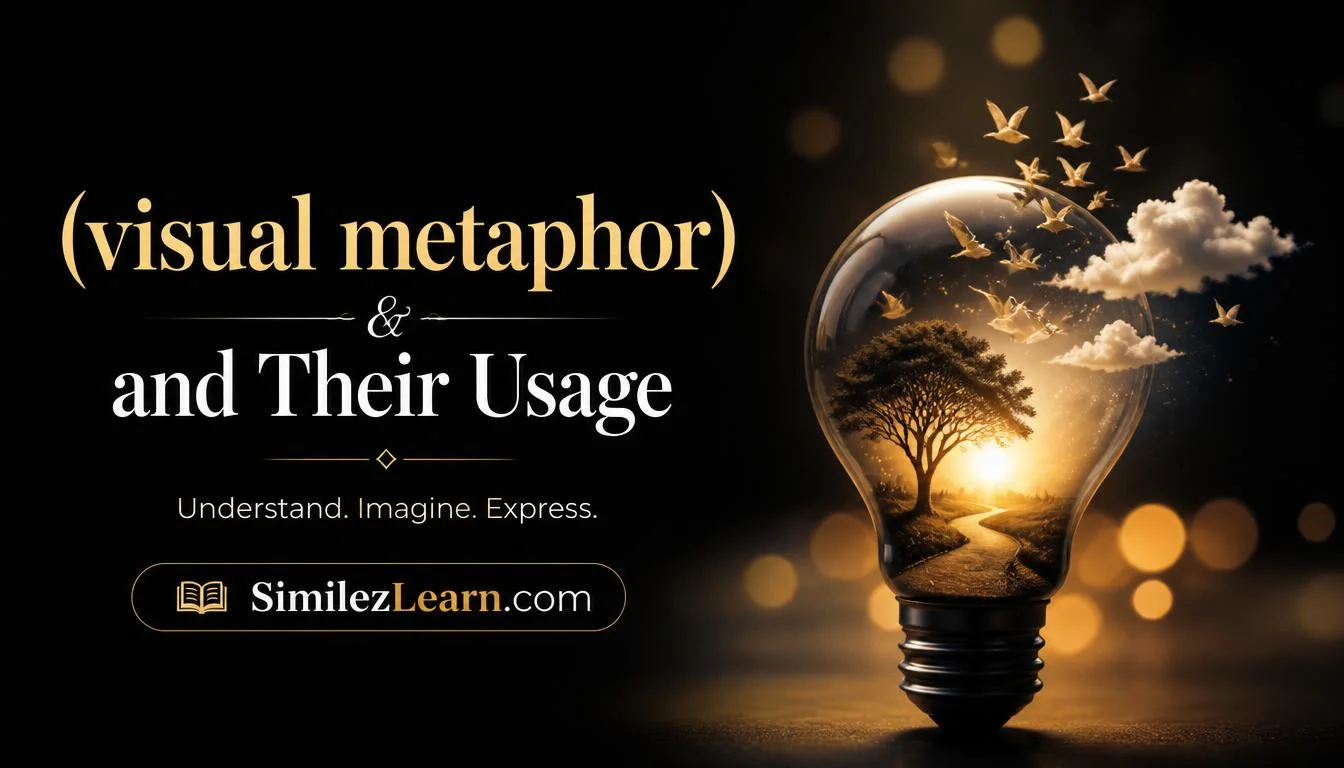
A visual metaphor is a powerful way to communicate an idea without explaining it directly. Instead of using only words, it uses an image, object, scene, or visual relationship to represent a deeper meaning.
For example, a light bulb can represent an idea, a bridge can represent connection, and a mountain can represent a difficult goal. The image is real, but its meaning goes beyond what we can literally see.
Visual metaphors appear everywhere today—from advertisements and films to websites, classroom presentations, social media posts, photography, and graphic design. Once you learn how they work, you will start noticing them in ordinary images around you.
This Updated for 2026 guide explains the meaning of a visual metaphor, how it works, its different types, 40 practical examples, and ways students, writers, designers, and creators can use visual metaphors effectively.
What Is a Visual Metaphor?
A visual metaphor is an image or visual composition that represents an idea, emotion, quality, or concept by comparing it with something else.
In simple terms, a visual metaphor shows one thing to communicate another meaning.
For example:
A person climbing a mountain can represent someone working toward a difficult goal.
The picture does not literally show “success” or “hard work.” Instead, the mountain provides a visual comparison that helps viewers understand those ideas.
Simple Definition
A visual metaphor is a visual comparison in which an object, image, or scene represents a deeper idea.
Some simple examples are:
- Light bulb → an idea
- Bridge → connection
- Broken chain → freedom
- Storm → emotional conflict
- Seedling → growth
- Mountain → challenge
- Open door → opportunity
- Candle → knowledge
The meaning may be widely recognized or created specifically for a particular context.
How a Visual Metaphor Works
A visual metaphor works by connecting a familiar visual object with an abstract concept.
Abstract ideas such as love, freedom, stress, ambition, fear, and hope are difficult to photograph directly. Visual metaphors give these ideas a physical form.
Concrete vs Abstract Meaning
Consider stress.
You cannot take a photograph of stress itself. However, you could show:
A person carrying an enormous backpack.
The backpack represents the weight of responsibilities, worries, or pressure.
The viewer makes the connection between the physical weight and emotional stress.
Why Visual Metaphors Are Effective
Visual metaphors can:
- Simplify complicated ideas
- Make information memorable
- Create emotional responses
- Improve storytelling
- Strengthen advertising messages
- Help students understand abstract concepts
- Make presentations more engaging
- Add depth to photographs and artwork
- Communicate quickly without many words
In everyday conversations, people often use visual metaphors to explain abstract ideas through familiar images, even if they do not consciously identify them as metaphors.
40 Visual Metaphor Examples and Meanings
The following examples show how ordinary objects and scenes can communicate deeper meanings.
1. Light Bulb as an Idea
Meaning: A light bulb represents inspiration, intelligence, or a new idea.
Example: A glowing bulb above someone’s head visually communicates, “I just had an idea.”
2. Mountain as a Challenge
Meaning: A mountain represents something difficult that requires effort to overcome.
Example: A person climbing toward a mountain peak can represent someone pursuing a difficult goal.
3. Bridge as Connection
Meaning: A bridge represents communication, relationships, or unity.
Example: Two communities connected by a bridge can symbolize cooperation.
4. Broken Chain as Freedom
Meaning: A broken chain can represent independence or release from restrictions.
Example: Open links separating from a chain can symbolize breaking free from limitations.
5. Seedling as Growth
Meaning: A young plant represents development, learning, or personal improvement.
Example: A seedling growing taller can represent a student developing new skills.
6. Storm as Emotional Conflict
Meaning: A storm can represent anger, sadness, confusion, or emotional struggle.
Example: A character standing beneath dark clouds can symbolize inner turmoil.
7. Sunrise as Hope
Meaning: Sunrise often represents renewal, optimism, and a fresh beginning.
Example: A person watching the sunrise can symbolize hope after a difficult period.
8. Open Door as Opportunity
Meaning: An open door represents a new possibility or chance.
Example: A person walking toward an open door can symbolize entering a new stage of life.
9. Cage as Restriction
Meaning: A cage represents feeling trapped or limited.
Example: A person reaching through cage bars can represent a desire for freedom.
10. Wings as Freedom
Meaning: Wings can symbolize independence, ambition, or liberation.
Example: Wings emerging behind a person can represent freedom from limitations.
11. Fire as Passion
Meaning: Fire can represent motivation, passion, enthusiasm, or strong emotion.
Example: Flames surrounding a person’s goal can represent intense determination.
12. Iceberg as Hidden Problems
Meaning: An iceberg can represent something whose visible part is much smaller than what lies underneath.
Example: A small visible iceberg above water can represent a problem with deeper hidden causes.
13. Ladder as Progress
Meaning: A ladder represents gradual movement toward achievement.
Example: Someone climbing a ladder toward a goal can symbolize career or personal progress.
14. Maze as Confusion
Meaning: A maze can represent uncertainty, complicated decisions, or difficulty finding direction.
Example: A person searching for an exit can symbolize someone trying to solve a difficult problem.
15. Road as Life’s Journey
Meaning: A road can represent progress, choices, and the journey through life.
Example: A long road disappearing toward the horizon can symbolize an uncertain future.
16. Anchor as Stability
Meaning: An anchor represents security, support, and stability.
Example: An anchor holding a boat steady can symbolize something that keeps a person grounded.
17. Heavy Backpack as Stress
Meaning: A heavy backpack represents emotional pressure or responsibilities.
Example: Someone struggling under an oversized backpack can symbolize feeling overwhelmed.
18. Broken Mirror as Identity Conflict
Meaning: A broken mirror can represent a damaged sense of self or emotional conflict.
Example: A person looking at their reflection through cracked glass can symbolize uncertainty about identity.
19. Key as Knowledge
Meaning: A key can represent information that unlocks understanding.
Example: A key opening a book-shaped door can symbolize education.
20. Puzzle as a Problem
Meaning: A puzzle represents a complex problem that requires thought.
Example: A person placing the final puzzle piece can symbolize finding a solution.
21. River as Change
Meaning: A flowing river can represent movement, time, and continuous change.
Example: A river moving through different landscapes can symbolize life’s changing stages.
22. Tree as Strength
Meaning: A strong tree can represent resilience and stability.
Example: A tree standing through strong winds can symbolize someone remaining strong during difficulties.
23. Butterfly as Transformation
Meaning: A butterfly represents change, development, and personal transformation.
Example: A butterfly emerging from a cocoon can symbolize a person’s new beginning.
24. Dark Cloud as Sadness
Meaning: A dark cloud can represent sadness or a difficult emotional period.
Example: A single person beneath a dark cloud can symbolize loneliness.
25. Fireworks as Excitement
Meaning: Fireworks can represent celebration, excitement, or sudden happiness.
Example: Fireworks behind a smiling person can symbolize an exciting achievement.
26. Compass as Direction
Meaning: A compass represents guidance, purpose, and decision-making.
Example: A traveler holding a compass at a crossroads can symbolize searching for direction.
27. Wall as Emotional Barrier
Meaning: A wall can represent distance, disagreement, or difficulty communicating.
Example: Two people standing on opposite sides of a wall can symbolize emotional separation.
28. Boat as an Emotional Journey
Meaning: A boat can represent navigating uncertain experiences.
Example: A small boat crossing rough water can symbolize someone facing emotional challenges.
29. Candle as Knowledge
Meaning: A candle can represent understanding that removes ignorance or confusion.
Example: One candle illuminating a dark room can symbolize education.
30. Phoenix as Rebirth
Meaning: A phoenix can represent recovery, renewal, and beginning again.
Example: A phoenix rising from ashes can symbolize overcoming failure.
31. Falling Leaves as Change
Meaning: Falling leaves can symbolize transition, aging, or letting go.
Example: A person walking through falling autumn leaves can represent entering a new stage of life.
32. Hourglass as Limited Time
Meaning: An hourglass represents time passing or a deadline approaching.
Example: Falling sand beside a deadline can emphasize the importance of using time wisely.
33. Garden as Personal Development
Meaning: A garden can represent emotional or intellectual growth.
Example: A neglected garden becoming healthy can symbolize personal improvement.
34. Locked Door as a Lost Opportunity
Meaning: A locked door can represent an obstacle or unavailable opportunity.
Example: Someone standing outside a locked door can symbolize being unable to move forward.
35. Sunflower as Happiness
Meaning: A sunflower can represent optimism, warmth, and positivity.
Example: A sunflower turning toward sunlight can symbolize someone seeking happiness.
36. Falling Dominoes as Consequences
Meaning: Dominoes can represent how one action can trigger a chain of events.
Example: One falling domino knocking down many others can symbolize cause and effect.
37. Rope as Support
Meaning: A rope can represent help, cooperation, or emotional support.
Example: One person pulling another upward with a rope can symbolize friendship.
38. Empty Chair as Absence
Meaning: An empty chair can represent someone who is missing.
Example: A single empty chair at a table can communicate loss or absence.
39. Growing Tree as Learning
Meaning: A growing tree can represent knowledge developing over time.
Example: Books placed around the roots of a growing tree can symbolize education.
40. Doorway to Light as Hope
Meaning: A bright doorway can represent hope, possibility, and a better future.
Example: A person walking from darkness toward a bright doorway can symbolize overcoming hardship.
Visual Metaphors in Everyday Life
Visual metaphors are everywhere in modern life.
You can find them in:
- Advertising
- Websites
- Mobile apps
- Movies
- Photography
- Posters
- News graphics
- School presentations
- Social media
- Product packaging
- Book covers
- Public campaigns
A company might show a seed becoming a tree to communicate business growth. A technology advertisement might show a bridge connecting two distant places to suggest communication.
Visual Metaphors in Advertising
Advertisers frequently use visual comparisons because images can communicate a message quickly.
For example:
A battery connected to a running shoe can represent energy and endurance.
The advertiser does not need a long paragraph explaining the product’s energy.
Visual Metaphors in Film
Filmmakers often use visual details to suggest emotions or themes.
A character walking through heavy rain might visually reinforce sadness or emotional struggle.
A bright sunrise after a difficult scene may suggest hope or a new beginning.
Visual Metaphors in Social Media
Social media creators can use visual metaphors to communicate ideas quickly.
For example:
- Mountain + person climbing = personal growth
- Sunrise + road = new beginning
- Broken chain = freedom
- Butterfly = transformation
- Storm clouds = emotional difficulty
Famous or Popular Visual Metaphors
Some visual metaphors have become widely recognized.
The Light Bulb
A light bulb is strongly associated with ideas and inspiration.
It is common in educational graphics, business presentations, and creative content.
The Heart
A heart commonly communicates love, affection, and emotional connection.
Its meaning is usually easy for viewers to understand.
The Bridge
A bridge often represents connection, communication, and cooperation.
It is especially useful when discussing relationships or communities.
The Mountain
A mountain can represent difficulty, ambition, or achievement.
The summit often becomes a visual goal.
The Butterfly
A butterfly commonly represents transformation and personal change.
Its connection to metamorphosis makes it particularly useful for this meaning.
Visual Metaphor vs Related Concepts
Visual metaphors are related to symbols, icons, illustrations, and literal images, but they serve different purposes.
| Concept | Main Purpose | Example |
|---|---|---|
| Visual metaphor | Communicates a deeper idea through comparison | Mountain = challenge |
| Symbol | Represents a recognized concept | Heart = love |
| Icon | Simplifies an object or action | Trash-can icon = delete |
| Literal image | Shows the subject directly | Photograph of a mountain |
| Illustration | Explains or decorates an idea | Drawing of a mountain |
| Infographic | Presents information visually | Chart showing growth |
Visual Metaphor vs Symbol
A symbol often has a widely recognized meaning.
A visual metaphor may depend more heavily on context.
For example, a heart usually represents love, while a bridge could represent friendship, communication, cooperation, or reconciliation depending on the image.
Visual Metaphor vs Literal Image
A literal photograph of a mountain simply shows a mountain.
A photograph of a person climbing a mountain while the surrounding design represents a career goal creates a visual metaphor for achievement.
How to Create a Visual Metaphor
Creating an effective visual metaphor starts with the idea rather than the picture.
Step 1: Choose an Abstract Concept
Start with something that is difficult to photograph directly.
Examples:
- Success
- Love
- Fear
- Hope
- Stress
- Freedom
- Anger
- Growth
- Failure
- Friendship
Step 2: Identify Its Main Quality
Ask what the concept feels like.
For example, stress may feel:
- Heavy
- Restrictive
- Overwhelming
- Difficult to escape
Step 3: Find a Physical Comparison
Choose something with similar qualities.
For stress:
A heavy backpack.
For freedom:
An open sky or broken chain.
For growth:
A seed becoming a tree.
Step 4: Add Context
Context helps viewers understand the intended meaning.
A person climbing a mountain becomes more clearly connected to achievement if a goal flag appears at the summit.
Step 5: Keep the Composition Simple
Do not overload the image with unnecessary objects.
One strong visual comparison is often more effective than ten weak ones.
Common Mistakes People Make With Visual Metaphors
1. Making the Image Too Complicated
A crowded design can hide the main message.
Keep the central metaphor easy to identify.
2. Using a Random Decorative Image
Not every meaningful-looking image is a visual metaphor.
There should be a clear relationship between the image and the concept.
3. Making the Meaning Too Obscure
Creative does not have to mean confusing.
If viewers cannot understand the connection, the metaphor may need more context.
4. Using Too Many Metaphors
Combining a mountain, storm, ocean, butterfly, and broken chain can create visual confusion.
Choose one dominant metaphor.
5. Ignoring the Audience
A visual metaphor for young students should usually be more direct than one created for an art exhibition.
Always consider who will see the image.
6. Relying Too Much on Text
A visual metaphor should contribute meaning visually.
Use text as support rather than making the entire message dependent on words.
Practical Uses of Visual Metaphors
In Essays
Writers can use visual metaphors as inspiration for descriptive language.
Example: A storm can represent a character’s emotional conflict.
In Poems
Poetry often relies on imagery and metaphor.
Example: A fading sunset can represent the ending of a relationship.
In Presentations
Visual metaphors can make abstract information memorable.
Example: A growing tree can represent business development.
In Classroom Projects
Students can create visual metaphors to demonstrate their understanding of literary devices.
Example: A bridge can represent communication between cultures.
In Social Media
Creators can use visual metaphors to communicate emotional messages quickly.
Example: A sunrise can represent starting over.
In Advertising
Brands can connect products with abstract benefits.
Example: Wings can represent freedom, speed, or possibility.
Tips for Creating Better Visual Metaphors
Before finalizing your image, ask:
- What message should viewers understand?
- What object naturally represents that message?
- Is the comparison clear?
- Does the image fit the audience?
- Is there unnecessary visual clutter?
- Does the image create an emotional response?
- Does the context strengthen the meaning?
From real-life writing experience, the strongest metaphors are usually simple enough to understand but meaningful enough to remember.
You do not need an elaborate design to create an effective visual metaphor.
Related Figurative Language Topics
If you are learning visual metaphor and figurative language, these topics make useful internal links:
- What Is a Metaphor?
- Metaphor vs Simile
- Types of Metaphors
- Examples of Figurative Language
- Personification Examples
- Symbolism in Literature
- Metaphors About Anger
- Metaphors for Happiness
- Metaphors for Love
- Metaphors for Sadness
These related subjects can help students and writers understand how figurative language works across both words and images.
Frequently Asked Questions
What is a visual metaphor?
A visual metaphor is an image that represents an idea, emotion, or concept by comparing it visually with something else. For example, a mountain can represent a difficult challenge.
What are some examples of visual metaphors?
Examples include a light bulb for an idea, a bridge for connection, a broken chain for freedom, a butterfly for transformation, and a mountain for achievement.
What is the purpose of a visual metaphor?
Its purpose is to communicate an abstract or complex idea through a familiar visual image. This can make the message easier to understand and remember.
What is the difference between a visual metaphor and a symbol?
A symbol usually has an established or commonly understood meaning, while a visual metaphor creates a comparison that may depend more strongly on context.
How can I create my own visual metaphor?
Start with an abstract idea, identify its main quality, choose a physical object with similar qualities, and combine them into a clear visual composition.
Conclusion
A visual metaphor turns an abstract idea into something viewers can see and understand. A mountain can become a challenge, a bridge can become connection, a seedling can become growth, and a sunrise can become hope.
These visual comparisons are useful for students, writers, teachers, designers, marketers, photographers, and social media creators. They can make complicated concepts simpler while adding emotional depth to communication.
The best visual metaphors are usually clear, purposeful, and memorable. Start with one idea, find an image that shares its qualities, and let the visual relationship communicate the deeper message. With practice, you can create visual metaphors that make your work more creative and meaningful.
DISCOVER MORE ARTICLES
Metaphor Pictures: 40 Creative Examples and Visual Ideas 2026
Metaphors for Being Angry: Easy Examples With Meanings 2026
Metaphors About Anger: Creative Ways to Describe Anger 2026
