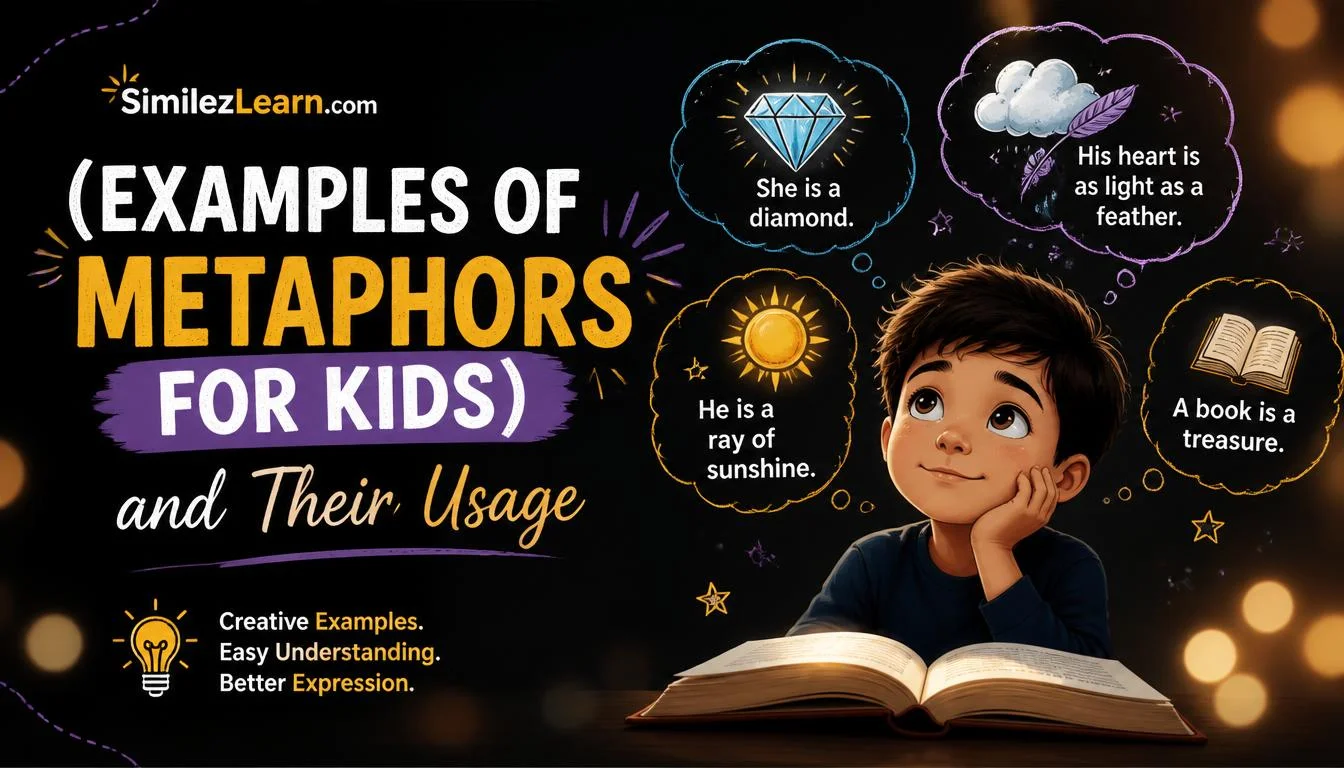
Metaphors can make language more colorful, creative, and fun. Instead of saying exactly what something is like, a metaphor makes a direct comparison to help readers imagine an idea more clearly. For kids, learning metaphors is a great way to make stories, poems, school assignments, conversations, and creative writing more interesting.
For example, instead of saying “The classroom was very noisy,” a child might write, “The classroom was a zoo.” The classroom is not literally a zoo, but the metaphor helps readers imagine how loud, busy, and energetic it was.
This guide to examples of metaphors for kids explains metaphors in simple language and provides 40 easy examples children can understand and use. Updated for 2026, these examples include familiar situations involving school, friends, family, nature, technology, emotions, and everyday life.
What Are Examples of Metaphors for Kids?
A metaphor is a figure of speech that says one thing is another thing to create a comparison.
It does not mean that the two things are literally the same. Instead, the comparison helps us picture an idea, feeling, person, place, or object.
For example:
“The moon is a silver coin.”
The moon is not really a coin. The metaphor compares its round shape and bright appearance to a silver coin.
Simple Definition of a Metaphor
A metaphor is a direct comparison between two different things.
Children can remember it this way:
A metaphor says something is something else to create a picture in your mind.
For example:
- “My brother is a monkey.”
- “The classroom was a zoo.”
- “Her smile is sunshine.”
- “The snow is a white blanket.”
These sentences are not meant literally. They use imaginative comparisons to make language more interesting.
How Metaphors Work
Metaphors work by taking something familiar and connecting it to something else.
Suppose a child wants to describe a very fast runner. Instead of saying:
“Ali runs very fast.”
The child could write:
“Ali is a rocket.”
Ali is not actually a rocket. The metaphor tells us that he moves very quickly.
Metaphors Create Pictures
One reason metaphors are useful for kids is that they help readers visualize ideas.
Consider:
“The sun was a golden ball in the sky.”
The reader can imagine the bright, round sun much more easily.
Metaphors Describe Feelings
Metaphors can also explain emotions that are difficult to see.
For example:
“Happiness is sunshine.”
This suggests that happiness feels warm, bright, and positive.
Metaphors Make Writing Interesting
A simple sentence gives information, but a metaphor adds imagination.
Simple: “The girl was very happy.”
Metaphorical: “The girl was a bouncing ball of happiness.”
The second sentence gives readers a stronger sense of energy and excitement.
40 Examples of Metaphors for Kids
Here are 40 easy and creative metaphor examples for kids. Each one includes a simple meaning and an example sentence.
1. The Classroom Is a Zoo
Meaning: The classroom is very noisy, busy, or energetic.
Example: “After lunch, our classroom was a zoo.”
2. Her Smile Is Sunshine
Meaning: Her smile makes people feel happy and warm.
Example: “Her smile is sunshine on a cloudy day.”
3. The Snow Is a White Blanket
Meaning: Snow covers the ground like a blanket.
Example: “The snow was a white blanket covering the garden.”
4. My Brother Is a Monkey
Meaning: The brother is playful, energetic, or always climbing around.
Example: “My little brother is a monkey when he plays.”
5. The Moon Is a Silver Coin
Meaning: The moon looks round and bright.
Example: “A silver coin hung in the dark sky.”
6. Her Voice Is Music
Meaning: Her voice sounds beautiful or pleasant.
Example: “Her voice is music to everyone in the room.”
7. The Wind Is a Whisper
Meaning: The wind is moving softly and quietly.
Example: “The wind was a whisper through the trees.”
8. My Dad Is a Rock
Meaning: Dad is strong, dependable, and supportive.
Example: “My dad is a rock when I need help.”
9. The City Is a Jungle
Meaning: The city is busy, crowded, and full of activity.
Example: “The city was a jungle of cars and people.”
10. The Stars Are Diamonds
Meaning: The stars look bright and sparkling.
Example: “The stars were diamonds scattered across the sky.”
11. The Baby Is an Alarm Clock
Meaning: The baby wakes people up by crying or making noise.
Example: “My baby brother is an alarm clock every morning.”
12. My Backpack Is a Treasure Chest
Meaning: The backpack contains many useful or interesting things.
Example: “My backpack is a treasure chest full of school supplies.”
13. The Ocean Is a Giant Mirror
Meaning: The ocean reflects light and images like a mirror.
Example: “The calm ocean became a giant mirror beneath the sun.”
14. The Clouds Are Cotton Balls
Meaning: The clouds look soft, fluffy, and white.
Example: “The clouds were cotton balls floating across the blue sky.”
15. His Room Is a Disaster Zone
Meaning: His room is extremely messy.
Example: “After the weekend, his bedroom was a disaster zone.”
16. The Computer Is My Helper
Meaning: The computer helps the person complete tasks.
Example: “My computer is my helper when I do homework.”
17. Her Eyes Are Stars
Meaning: Her eyes are bright and beautiful.
Example: “Her eyes were stars shining with excitement.”
18. The Road Is a Ribbon
Meaning: The road stretches across the land in a long, narrow shape.
Example: “The road was a ribbon winding through the hills.”
19. My Teacher Is a Lighthouse
Meaning: The teacher guides and helps students.
Example: “My teacher is a lighthouse guiding us through difficult lessons.”
20. Knowledge Is a Key
Meaning: Learning gives people opportunities and helps them solve problems.
Example: “Knowledge is a key that can open many doors.”
21. Time Is a Thief
Meaning: Time seems to disappear quickly.
Example: “Time is a thief that steals our afternoons.”
22. The Baby Is a Little Tornado
Meaning: The baby moves around quickly and creates lots of activity.
Example: “Our toddler was a little tornado during playtime.”
23. The Sun Is a Golden Lamp
Meaning: The sun gives light like a bright lamp.
Example: “The sun was a golden lamp above the playground.”
24. My Friend Is a Sunshine Machine
Meaning: The friend makes other people feel cheerful.
Example: “Sara is a sunshine machine who makes everyone laugh.”
25. The Test Was a Mountain
Meaning: The test felt difficult and challenging.
Example: “The science test was a mountain I had to climb.”
26. Fear Is a Shadow
Meaning: Fear can follow someone and make them feel worried.
Example: “Fear was a shadow following him down the dark hallway.”
27. Anger Is a Fire
Meaning: Anger can become hot and intense.
Example: “His anger was a fire that grew after every argument.”
28. Happiness Is a Balloon
Meaning: Happiness can feel light, exciting, and uplifting.
Example: “Her happiness was a balloon floating through the day.”
29. The Playground Is an Adventure Land
Meaning: The playground feels exciting and full of possibilities.
Example: “The playground was an adventure land after school.”
30. His Laugh Is Thunder
Meaning: His laugh is very loud and powerful.
Example: “His laugh was thunder across the classroom.”
31. The River Is a Snake
Meaning: The river curves and twists through the land.
Example: “The river was a snake winding between the green hills.”
32. My Pencil Is a Magic Wand
Meaning: Writing with the pencil helps create ideas and stories.
Example: “My pencil is a magic wand when I write stories.”
33. The Library Is a Treasure Chest
Meaning: A library contains many valuable books and ideas.
Example: “The library is a treasure chest of knowledge.”
34. The Wind Is a Dancer
Meaning: The wind moves and swirls gracefully.
Example: “The wind was a dancer moving through the trees.”
35. The Computer Screen Is a Window
Meaning: A screen gives access to information and places beyond the immediate surroundings.
Example: “My computer screen is a window to a world of information.”
36. Friendship Is a Bridge
Meaning: Friendship connects people and helps them understand each other.
Example: “Friendship is a bridge between two different hearts.”
37. The Playground Was a Battlefield
Meaning: The children were competing intensely.
Example: “During the game, the playground became a battlefield.”
38. Her Words Were Arrows
Meaning: Her words were powerful and could hurt or strongly affect others.
Example: “Her angry words were arrows that hurt his feelings.”
39. The Morning Was a Fresh Page
Meaning: A new day provides a chance to begin again.
Example: “The morning was a fresh page waiting for a new story.”
40. Dreams Are Seeds
Meaning: Dreams can grow into achievements when people work toward them.
Example: “Dreams are seeds that grow with effort and patience.”
Examples of Metaphors in Everyday Life
Children encounter metaphors more often than they might realize.
At School
Students may hear or use expressions such as:
“The classroom was a zoo.”
This is useful when describing a noisy or chaotic classroom in a story or school assignment.
At Home
A parent might say:
“You are a little tornado today.”
This could describe a child who is moving quickly around the house and making everything lively.
With Friends
Children often use creative comparisons when talking about their friends.
“You are my sunshine.”
This suggests that a friend brings happiness and positive energy.
In Sports
Sports provide many opportunities for metaphors.
“He is a rocket on the soccer field.”
The metaphor means he moves extremely quickly.
In Technology
Modern kids can also use metaphors involving phones, computers, games, and the internet.
“My phone is my doorway to the world.”
The phone is not literally a doorway, but it provides access to information and communication.
In everyday conversations, people often use metaphors for kids without thinking about the grammar behind them. Once children learn to recognize these comparisons, they can begin creating their own.
Famous or Popular Metaphor Examples
Some metaphors are popular because they are easy to understand and useful in many situations.
“Time Is Money”
This common metaphor suggests that time is valuable and should not be wasted.
Example: “Remember, time is money, so use your afternoon wisely.”
“The World Is a Stage”
This metaphor compares life to a performance.
Example: “The world is a stage, and everyone has a part to play.”
“Life Is a Journey”
This metaphor compares life to traveling from one place to another.
Example: “Life is a journey filled with unexpected turns.”
These examples show children how metaphors can express large ideas using familiar images.
Examples of Metaphors for Kids vs Related Concepts
Children often confuse metaphors with similes and other types of figurative language.
| Type | What It Does | Example |
|---|---|---|
| Metaphor | Makes a direct comparison | “The moon is a silver coin.” |
| Simile | Compares using “like” or “as” | “The moon is like a silver coin.” |
| Personification | Gives human qualities to nonhuman things | “The moon smiled at us.” |
| Idiom | Uses a common expression with a special meaning | “Break a leg.” |
| Literal language | Says exactly what something means | “The moon is bright tonight.” |
Metaphor vs Simile
The easiest way to tell them apart is to look for “like” or “as.”
Metaphor: “The classroom is a zoo.”
Simile: “The classroom is like a zoo.”
Both comparisons are useful, but they are structured differently.
Metaphor vs Personification
A metaphor compares two different things.
“My teacher is a lighthouse.”
Personification gives human actions or qualities to something nonhuman.
“The sun smiled at us.”
Understanding this difference helps students identify figurative language correctly.
How to Create Metaphors for Kids
Creating a metaphor can be a fun classroom activity.
Step 1: Choose Something to Describe
Start with an object, person, place, or feeling.
For example:
A very fast runner
Step 2: Think About Its Main Quality
Ask:
What makes this person special?
The answer might be:
Speed.
Step 3: Find Something With the Same Quality
Think of things that are extremely fast.
A rocket is a good choice.
Step 4: Make a Direct Comparison
Write:
“The runner is a rocket.”
Step 5: Add Details
Make the sentence more interesting:
“The runner was a rocket flying toward the finish line.”
Although the runner is not literally a rocket, the comparison creates a vivid image.
Easy Metaphor Formula for Students
Students can use this simple formula:
Thing + is + imaginative comparison
Examples:
- The sun is a golden ball.
- My teacher is a lighthouse.
- The library is a treasure chest.
- My pencil is a magic wand.
- Friendship is a bridge.
Once children understand this formula, they can experiment with their own creative comparisons.
Practical Uses of Metaphors for Kids
Metaphors can improve many types of writing.
In Essays
Metaphors can make school essays more descriptive.
Example: “Knowledge is a key that opens doors to new opportunities.”
In Poems
Poetry often uses metaphors to create strong images.
Example: “The moon is a silver boat sailing across the night.”
In Stories
Metaphors can make characters and settings more memorable.
Example: “The forest was a giant green cathedral.”
In Captions
Kids can use short metaphors in creative captions.
Example: “Weekend adventures are golden memories.”
In Daily Conversation
Metaphors can make everyday speech more expressive.
Example: “My little sister is a tornado today!”
Common Mistakes People Make With Metaphors
Learning metaphors is easy once children understand a few common mistakes.
1. Taking the Metaphor Literally
If someone says:
“My teacher is a lighthouse,”
the teacher is not actually a lighthouse.
The metaphor means the teacher guides and supports students.
2. Confusing Metaphors With Similes
Remember:
Metaphor: “The boy is a rocket.”
Simile: “The boy is like a rocket.”
The word “like” changes the type of comparison.
3. Choosing an Unclear Comparison
A metaphor should help the reader understand something.
Weak:
“The book is a refrigerator.”
Unless there is a clear reason for this comparison, the reader may become confused.
Better:
“The book is a treasure chest.”
This clearly suggests that the book contains valuable ideas.
4. Mixing Different Metaphors
Avoid putting too many unrelated comparisons into one sentence.
Confusing:
“Her happiness was a rocket, a river, and a sleeping mountain.”
Better:
“Her happiness was a rocket soaring into the sky.”
5. Using Too Many Metaphors
Metaphors are powerful, but using one in every sentence can make writing difficult to follow.
Use them where they add meaning or imagination.
Tips for Teaching Metaphors to Kids
Parents and teachers can make metaphor lessons interactive.
Use Pictures
Show children pictures of objects such as clouds, rockets, oceans, or animals. Ask them what each object could represent.
For example:
Rocket → speed
Then create:
“The runner is a rocket.”
Play a Comparison Game
Give students two words and ask them to connect them creatively.
For example:
Teacher + lighthouse
Possible answer:
“My teacher is a lighthouse.”
Ask “Why?”
After students create a metaphor, ask them to explain it.
For example:
“The library is a treasure chest.”
Why?
Because it contains valuable books and information.
This helps children understand that a good metaphor should have a meaningful connection.
Internal Link Ideas for Related Topics
If this article is published on an educational website, useful internal links could include:
- What Is a Metaphor?
- Metaphor Examples for Students
- Simile Examples for Kids
- Metaphor vs Simile
- Personification Examples for Kids
- Examples of Figurative Language
- Funny Metaphors for Kids
- Metaphor Exercises for Class 5
- Easy Similes for Children
- Types of Figurative Language
These related topics can help students continue learning about creative language and improve their vocabulary.
Frequently Asked Questions About Examples of Metaphors for Kids
What is a metaphor for kids?
A metaphor is a creative comparison that says one thing is another thing. It helps children describe ideas, objects, people, and feelings in an imaginative way.
What is an easy example of a metaphor?
An easy example is “The sun is a golden ball.” The sun is not literally a ball, but the comparison describes its round, bright appearance.
What are five metaphors for kids?
Five simple examples are:
- The classroom is a zoo.
- Her smile is sunshine.
- The moon is a silver coin.
- My teacher is a lighthouse.
- Friendship is a bridge.
How can kids make their own metaphors?
Kids can choose something they want to describe, identify its main quality, find another thing with a similar quality, and connect the two directly.
For example, if someone runs quickly, a child might write “He is a rocket.”
Why should kids learn metaphors?
Metaphors help children develop creative writing skills, vocabulary, reading comprehension, and descriptive language. They also make essays, stories, poems, and conversations more interesting.
Conclusion
Learning examples of metaphors for kids gives children a simple way to make their language more creative and expressive. A metaphor can turn an ordinary sentence into a memorable picture, such as “The classroom is a zoo” or “The stars are diamonds.”
The key is to remember that metaphors are not literal statements. They are imaginative comparisons that help readers see, feel, or understand something in a new way.
Encourage children to look for metaphors in books, conversations, songs, classroom activities, and everyday life. Then challenge them to create their own. With regular practice, even simple ideas can become colorful and engaging pieces of writing.
DISCOVER MORE ARTICLES
Anger Metaphors: 40 Creative Examples and Meanings 2026
Metaphor for Excitement: 50+ Creative Examples Explained 2026
Metaphors for the Beach: 40 Creative Ideas to Explore 2026
