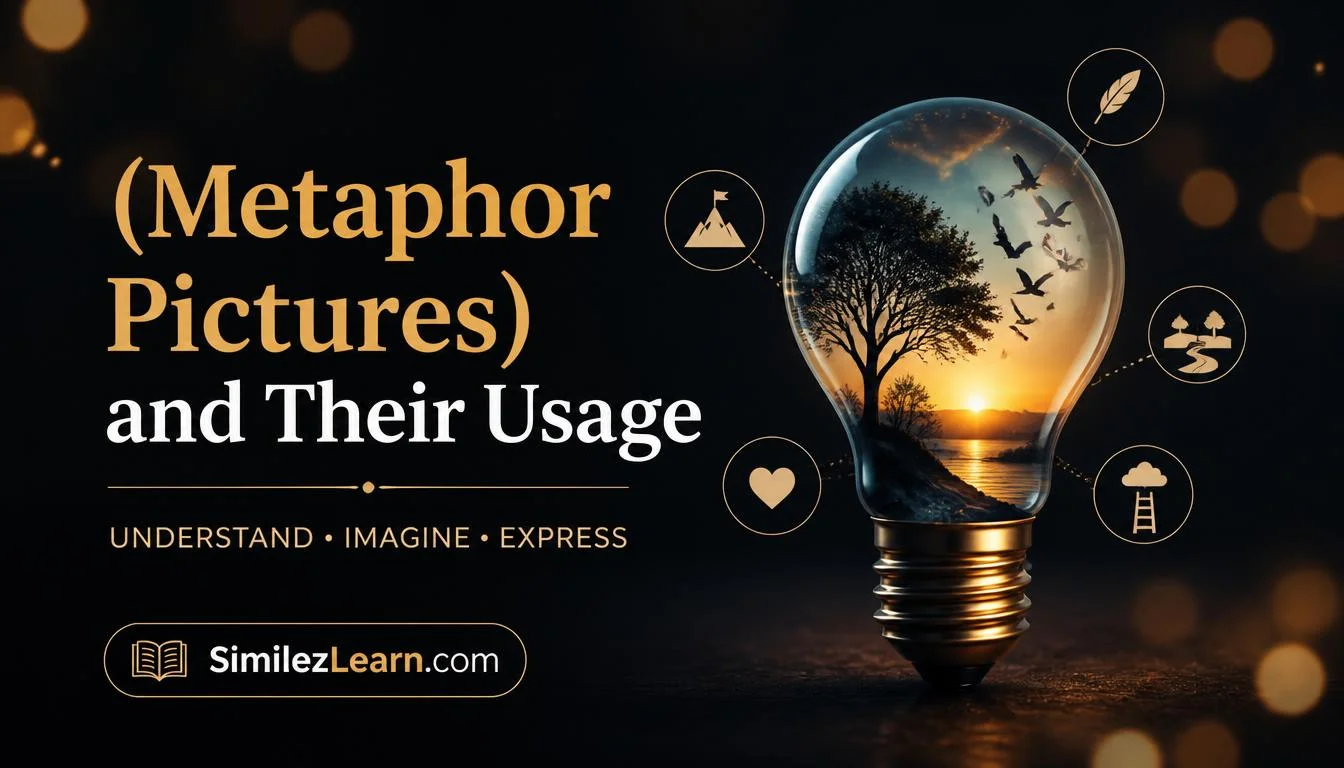
A metaphor picture is a visual way of expressing an idea by showing one thing as another. Instead of explaining an emotion, concept, or message with words alone, a metaphor picture uses an image to help viewers understand the deeper meaning.
For example, a picture of a light bulb can represent an idea, while a broken chain can represent freedom. A storm may represent anger or emotional struggle, and a rising sun can symbolize hope or a fresh beginning.
Metaphor pictures are useful for students, teachers, writers, artists, designers, and social media creators. They can make abstract ideas easier to understand and remember.
Updated for 2026, this guide explains what metaphor pictures are, how visual metaphors work, and how to create meaningful examples for school projects, presentations, essays, poems, captions, and creative designs.
What Are Metaphor Pictures?
Metaphor pictures are images that represent an idea, feeling, situation, or concept through a visual comparison.
A normal picture may simply show an object. A metaphor picture goes further by making the object stand for something else.
For example:
A picture of a bridge can represent connection.
The bridge is physically connecting two places, but visually it can also represent people, ideas, cultures, or relationships coming together.
Simple Definition of Metaphor Pictures
A metaphor picture is a visual comparison in which an image represents a different idea or meaning.
Common examples include:
- A light bulb = an idea
- A heart = love
- A storm = emotional difficulty
- A ladder = progress
- A broken chain = freedom
- A road = a journey or life path
- A seedling = growth
- A mountain = a difficult challenge
The picture does not always need words because the visual comparison communicates the message.
How Metaphor Pictures Work
Visual metaphors work by connecting a familiar object with an abstract idea.
People understand concrete objects more easily than abstract concepts. It can be difficult to draw “success,” “hope,” or “fear” directly, but these ideas can be represented through familiar images.
Concrete and Abstract Ideas
Consider the idea of success.
You cannot physically photograph “success” itself. However, you can show:
A person standing at the top of a mountain.
The mountain represents the challenge, while reaching the summit represents achievement.
Why Visual Metaphors Are Effective
Metaphor pictures can:
- Make difficult ideas easier to understand
- Create emotional reactions
- Improve visual storytelling
- Help students remember concepts
- Make presentations more interesting
- Strengthen advertisements and designs
- Add depth to social media content
- Give creative writing a visual dimension
In everyday conversations, people often use metaphorical images to explain ideas quickly, even when they do not call them metaphors.
40 Metaphor Picture Ideas With Meanings
Here are 40 metaphor picture examples you can use for school projects, creative writing, presentations, artwork, or visual content.
1. Light Bulb for an Idea
Meaning: A light bulb can represent inspiration, intelligence, or a new idea.
Picture idea: Show a glowing light bulb above a person’s head.
2. Mountain for a Challenge
Meaning: A mountain can represent a difficult goal or obstacle.
Picture idea: Show a person climbing a steep mountain toward the summit.
3. Broken Chain for Freedom
Meaning: A broken chain can symbolize freedom from restrictions.
Picture idea: Show metal links separating with light appearing behind them.
4. Bridge for Connection
Meaning: A bridge can represent relationships, communication, or unity.
Picture idea: Show two separated locations connected by a bridge.
5. Seedling for Growth
Meaning: A young plant can represent personal development or learning.
Picture idea: Show a small seedling growing from the soil.
6. Storm for Anger
Meaning: A storm can represent emotional conflict, anger, or inner struggle.
Picture idea: Show dark clouds and lightning surrounding a person.
7. Sunrise for Hope
Meaning: A sunrise can symbolize a fresh start or renewed hope.
Picture idea: Show sunlight appearing after a dark night.
8. Road for Life
Meaning: A road can represent a person’s journey through life.
Picture idea: Show a long road disappearing toward the horizon.
9. Candle for Knowledge
Meaning: A candle can represent knowledge illuminating darkness.
Picture idea: Show one candle lighting a dark room.
10. Clock for Time
Meaning: A clock can represent the passing or limited nature of time.
Picture idea: Show a large clock with fading calendar pages around it.
11. Open Door for Opportunity
Meaning: An open door can represent a new opportunity.
Picture idea: Show someone standing before an open door leading toward bright surroundings.
12. Cage for Feeling Trapped
Meaning: A cage can represent emotional, social, or personal restrictions.
Picture idea: Show a person outside or inside a cage with an open space nearby.
13. Wings for Freedom
Meaning: Wings can represent independence, freedom, or ambition.
Picture idea: Show a person with symbolic wings rising above obstacles.
14. Anchor for Stability
Meaning: An anchor can represent security, support, or something that keeps a person grounded.
Picture idea: Show an anchor beneath a person standing on a moving boat.
15. Fire for Passion
Meaning: Fire can symbolize strong passion, motivation, or enthusiasm.
Picture idea: Show flames surrounding an object representing a person’s dream.
16. Iceberg for Hidden Feelings
Meaning: An iceberg can represent emotions or problems that are larger beneath the surface.
Picture idea: Show a small visible iceberg section above water and a much larger section underwater.
17. Maze for Confusion
Meaning: A maze can represent uncertainty or difficulty finding the right solution.
Picture idea: Show a person searching for an exit in a complicated maze.
18. Ladder for Progress
Meaning: A ladder can represent gradual improvement or achievement.
Picture idea: Show someone climbing toward a goal at the top.
19. Empty Road for Loneliness
Meaning: An empty road can symbolize isolation or loneliness.
Picture idea: Show one person walking alone on a long empty road.
20. Heavy Backpack for Stress
Meaning: A heavy backpack can represent emotional pressure or responsibilities.
Picture idea: Show someone struggling to carry an oversized backpack.
21. Mirror for Self-Reflection
Meaning: A mirror can represent self-awareness and understanding oneself.
Picture idea: Show a person looking into a mirror with a thoughtful expression.
22. Puzzle for a Problem
Meaning: A puzzle can represent a complicated problem that needs to be solved.
Picture idea: Show someone connecting the final missing pieces.
23. Key for Knowledge
Meaning: A key can represent information that unlocks understanding.
Picture idea: Show a key opening a door labeled with a symbolic question mark.
24. River for Change
Meaning: A river can represent continuous movement and change.
Picture idea: Show a river traveling through different landscapes.
25. Tree for Strength
Meaning: A strong tree can represent resilience, stability, and personal strength.
Picture idea: Show a large tree standing firmly during strong winds.
26. Butterfly for Transformation
Meaning: A butterfly can represent personal transformation or a new stage of life.
Picture idea: Show a butterfly emerging from its cocoon.
27. Broken Glass for a Broken Relationship
Meaning: Broken glass can symbolize damage, separation, or emotional pain.
Picture idea: Show two people separated by cracked glass.
28. Compass for Direction
Meaning: A compass can represent guidance and finding one’s purpose.
Picture idea: Show a traveler holding a compass at a crossroads.
29. Boat for Emotional Journey
Meaning: A boat can represent navigating difficult or changing emotions.
Picture idea: Show a small boat traveling through calm and rough waters.
30. Wall for Emotional Barriers
Meaning: A wall can represent emotional distance or barriers between people.
Picture idea: Show two people standing on opposite sides of a wall.
31. Phoenix for Rebirth
Meaning: A phoenix can symbolize starting again after hardship.
Picture idea: Show a bird rising from ashes.
32. Cloud for Sadness
Meaning: A dark cloud can represent sadness or a difficult mood.
Picture idea: Show one person beneath a dark cloud while the surrounding area is bright.
33. Sunflower for Happiness
Meaning: A sunflower can represent positivity, warmth, and happiness.
Picture idea: Show a bright sunflower turning toward sunlight.
34. Hourglass for Limited Time
Meaning: An hourglass can symbolize time running out.
Picture idea: Show sand falling through an hourglass beside a deadline.
35. Prison Bars for Fear
Meaning: Prison bars can represent fear that prevents someone from moving forward.
Picture idea: Show a person reaching toward an open space beyond the bars.
36. Garden for Personal Growth
Meaning: A garden can represent a person’s emotional or intellectual development.
Picture idea: Show a neglected garden gradually becoming healthy and colorful.
37. Fireworks for Excitement
Meaning: Fireworks can symbolize celebration, excitement, or sudden happiness.
Picture idea: Show colorful fireworks above a person celebrating good news.
38. Falling Leaves for Change
Meaning: Falling leaves can represent transition, aging, or letting go.
Picture idea: Show leaves falling as a person walks into a new season.
39. Sunrise Road for a New Beginning
Meaning: A road leading toward sunrise can represent hope and a fresh chapter.
Picture idea: Show a person walking toward a bright horizon.
40. Growing Tree for Learning
Meaning: A growing tree can represent knowledge developing over time.
Picture idea: Show the tree growing taller as books appear around its roots.
Metaphor Pictures in Everyday Life
Visual metaphors appear in many places, including advertisements, educational materials, websites, posters, films, presentations, and social media.
A designer might use a light bulb to represent innovation. A motivational poster might show a mountain climber to represent success. A business presentation might use a bridge to communicate cooperation.
In everyday conversations, people often use metaphorical ideas to describe things they cannot physically see.
Metaphor Pictures in Education
Teachers can use visual metaphors to help students understand abstract subjects.
For example:
A tree with branches can represent a family tree.
The branches visually communicate relationships between different family members.
Another example is:
A staircase can represent levels of learning.
Each step suggests progress from one stage to another.
Metaphor Pictures in Presentations
Visual metaphors can make PowerPoint or classroom presentations more memorable.
Instead of writing:
“Our company is growing.”
A presentation could show:
A small plant developing into a large tree.
The image communicates growth without requiring several sentences.
Metaphor Pictures on Social Media
Social media creators can use visual metaphors to communicate emotional or motivational messages.
Examples include:
- A sunrise for a fresh start
- A mountain for overcoming challenges
- A broken chain for freedom
- A butterfly for transformation
- A road for personal growth
Famous or Popular Visual Metaphors
Some metaphor pictures have become widely recognizable because people repeatedly associate certain images with particular ideas.
Light Bulb = Idea
The light bulb is one of the most familiar visual symbols for an idea or moment of inspiration.
Heart = Love
A heart is commonly used to communicate love, affection, and emotional connection.
Dove = Peace
A dove is often used as a visual representation of peace.
Broken Chain = Freedom
Broken chains can communicate release from restrictions or oppression.
Mountain = Achievement
A mountain can symbolize a difficult challenge and the achievement of reaching the top.
These associations are useful because viewers can understand the intended message quickly.
Metaphor Pictures vs Related Concepts
Visual metaphors are closely related to symbols, illustrations, and literal images, but they are not exactly the same.
| Visual Type | Purpose | Example |
|---|---|---|
| Metaphor picture | Represents an abstract idea through comparison | Mountain = challenge |
| Symbol | Represents an accepted idea or concept | Heart = love |
| Literal picture | Shows the actual subject | Photo of a mountain |
| Illustration | Visually explains or decorates an idea | Drawing of a mountain |
| Icon | Simplified visual representation | Small heart icon |
| Infographic | Communicates information visually | Chart showing growth |
Metaphor Picture vs Literal Picture
A literal picture shows what something actually looks like.
A metaphor picture asks the viewer to understand an additional meaning.
For example:
A photograph of a mountain = literal image.
A mountain representing a difficult goal = metaphorical image.
Metaphor Picture vs Symbol
Symbols usually have widely recognized meanings.
A metaphor picture can be more creative and context-dependent.
For example, a heart commonly represents love, while a bridge could represent connection, cooperation, friendship, or communication depending on the context.
How to Create Metaphor Pictures
Creating a strong visual metaphor does not require complicated design skills.
Step 1: Choose the Main Idea
Start with the concept you want to communicate.
Examples:
- Hope
- Anger
- Success
- Fear
- Love
- Growth
- Failure
- Freedom
- Stress
- Friendship
Step 2: Identify Its Main Quality
Ask what the idea feels like.
For example, stress may feel:
- Heavy
- Restrictive
- Overwhelming
- Endless
Step 3: Find a Physical Object
Choose something with similar qualities.
For stress, you could use:
A heavy backpack.
The backpack visually represents the weight of responsibilities.
Step 4: Add Context
The surrounding details can make the metaphor clearer.
For example, show a person carrying a huge backpack while walking uphill.
The hill adds another layer of difficulty.
Step 5: Keep the Image Simple
A strong metaphor picture does not need dozens of objects.
One clear image can communicate more effectively than a crowded design.
Common Mistakes People Make With Metaphor Pictures
1. Making the Meaning Too Difficult
If viewers cannot understand the intended comparison, the image may lose its purpose.
Choose familiar objects when possible.
2. Adding Too Many Symbols
Too many visual elements can make the message confusing.
Focus on one main metaphor.
3. Using a Generic Image Without Purpose
Not every decorative picture is a metaphor.
A picture becomes metaphorical when it represents a deeper concept.
4. Ignoring Context
A mountain may represent achievement in one design but loneliness or isolation in another.
Context matters.
5. Explaining Everything With Text
A visual metaphor should contribute meaning on its own.
Use text only when it improves clarity.
6. Choosing an Unrelated Comparison
The image should share meaningful qualities with the idea.
For example, using a flower to represent anger may confuse readers unless the surrounding context explains the connection.
Practical Uses of Metaphor Pictures
Metaphor pictures are useful in many creative and educational situations.
For School Projects
Students can use visual metaphors to explain abstract ideas.
Example: A bridge can represent communication between different cultures.
For Essays
Writers can use visual metaphors as inspiration for descriptive paragraphs.
Example: A storm can represent a character’s emotional conflict.
For Poems
Poets can turn emotions into visual scenes.
Example: A fading sunset can represent the end of a relationship.
For Presentations
Visual metaphors can make complex ideas easier to remember.
Example: A growing tree can represent business development.
For Social Media
Creators can communicate ideas quickly through a single powerful image.
Example: A road toward sunrise can represent a new beginning.
For Captions
A short caption can reinforce the metaphor.
Example:
“Every mountain begins with one step.”
The mountain represents a difficult goal.
Tips for Choosing the Best Metaphor Picture
Before using an image, ask yourself:
- What idea am I trying to communicate?
- What physical object shares the same quality?
- Will viewers understand the comparison?
- Does the image fit my audience?
- Is the design simple enough?
- Does the picture create an emotional response?
- Does the context make the metaphor clear?
From real-life writing experience, the strongest visual metaphors are usually simple, familiar, and emotionally relevant.
A single powerful image can sometimes communicate more than an entire paragraph.
Internal Link Ideas for Related Topics
If you are building a website about English, literary devices, or creative writing, useful internal links could include:
- What Is a Metaphor?
- Metaphor vs Simile
- Types of Metaphors
- Examples of Figurative Language
- Personification Examples
- Simile Examples
- Metaphors About Anger
- Metaphors for Happiness
- Metaphors for Love
- Metaphors for Sadness
These related topics help readers move naturally from visual metaphors to broader figurative-language concepts.
Frequently Asked Questions
What is a metaphor picture?
A metaphor picture is an image that represents an idea, emotion, or concept through a visual comparison. For example, a mountain can represent a difficult challenge.
What are some examples of metaphor pictures?
Common examples include a light bulb for an idea, a bridge for connection, a broken chain for freedom, a seedling for growth, and a storm for anger.
What is the difference between a metaphor picture and a symbol?
A symbol usually has a commonly recognized meaning, while a metaphor picture creates a visual comparison that can depend more heavily on context.
How do I make a metaphor picture?
Choose an abstract idea, identify its main quality, find a physical object with a similar quality, and create a simple image that connects the two.
Why are metaphor pictures useful?
They make abstract concepts easier to understand and remember. They are especially useful in education, presentations, advertising, storytelling, poetry, and social media.
Conclusion
Metaphor pictures transform abstract ideas into visual experiences. Instead of simply telling viewers about hope, anger, freedom, growth, stress, or success, a carefully chosen image can allow them to understand the idea immediately.
A mountain can become a challenge, a seedling can become growth, a bridge can become connection, and a sunrise can become hope. These visual comparisons make communication more memorable and creative.
Whether you are a student preparing a project, a teacher explaining figurative language, a writer developing imagery, or a creator designing social content, practice turning abstract ideas into simple visual comparisons. The best metaphor picture is usually one that is clear, meaningful, and easy to remember.
DISCOVER MORE ARTICLES
Metaphors for Being Angry: Easy Examples With Meanings 2026
Metaphors About Anger: Creative Ways to Describe Anger 2026
Metaphor for Excited: Creative Ways to Show Emotion 2026
