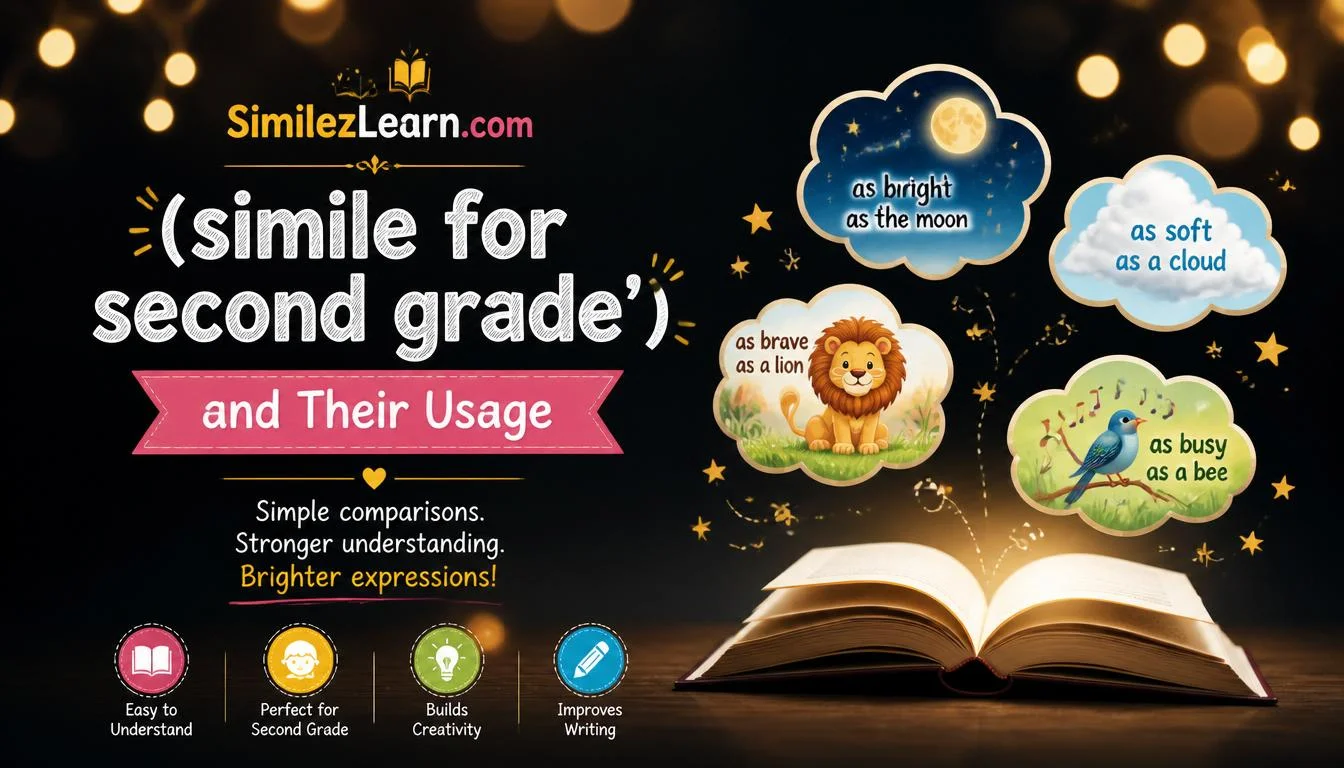
Learning English becomes more enjoyable when students can connect words with pictures and real-life situations. A simile for second grade is a simple way to teach young learners how to compare two different things using words like “like” or “as.”
For second-grade students, similes make reading, writing, and speaking more creative. Instead of saying something is simply beautiful, fast, or bright, students can use comparisons to create stronger images in the reader’s mind.
Updated for 2026, this guide explains similes in an easy way with child-friendly examples, classroom activities, writing tips, and practical uses. Whether you are a student, teacher, parent, or beginner writer, learning similes can help improve vocabulary and creativity.
In everyday conversations, people often use similes to describe feelings, objects, animals, and experiences. Once children understand how similes work, they can use them in stories, poems, school assignments, and daily conversations.
What Is a Simile for Second Grade?
A simile for second grade is a comparison between two different things using the words “like” or “as.”
A simile helps students describe something by comparing it with something familiar.
For example:
- The rabbit is as fast as lightning.
- The pillow is as soft as cotton.
- The stars shine like diamonds.
These sentences do not mean the rabbit is actually lightning or the stars are real diamonds. They only show a similar quality, such as speed or brightness.
A simple definition for second graders:
A simile compares two things using “like” or “as” to make descriptions more interesting.
From real-life writing experience, children understand language faster when examples connect with things they see every day.
How Similes Work for Second Grade Students
Similes work by helping students imagine something clearly.
A simile has three simple parts:
The Thing We Describe
This is the person, animal, object, or idea we are talking about.
Example:
The puppy
The Comparison Word
Most similes use:
- Like
- As
Example:
The puppy is like…
The Comparison
This tells what the thing is similar to.
Example:
The puppy is like a fluffy cloud.
Together:
The puppy is like a fluffy cloud.
This tells us that the puppy is soft and cute.
Why Learning Similes Is Important in Second Grade
Learning similes helps children become better readers and writers.
- Make stories more interesting
- Describe things clearly
- Improve vocabulary
- Understand poems
- Create creative sentences
- Express feelings better
Teachers often introduce similes in second grade because children at this age enjoy imagination and storytelling.
A sentence like:
“The flower is beautiful”
becomes more exciting:
“The flower is as bright as the sun.”
How Similes Are Used in Everyday Life
Children hear similes in many places without realizing it.
Similes appear in:
- Children’s books
- Cartoons
- Songs
- Classroom lessons
- Conversations
- Poems
- Storytelling
In everyday conversations, people often use similes to make their ideas easier to understand.
Examples:
- My little brother sleeps like a log.
- The classroom was as quiet as a mouse.
- The ice cream was as cold as ice.
These simple comparisons help children understand descriptions quickly.
Benefits of Similes for Young Learners
Similes provide many learning benefits for second-grade students.
Builds Imagination
Similes encourage children to think creatively.
Example:
The clouds are like fluffy pillows.
Students imagine soft clouds floating in the sky.
Improves Writing Skills
Children learn how to make ordinary sentences more interesting.
Simple:
The dog is cute.
Better:
The dog is as cute as a teddy bear.
Helps Reading Skills
Understanding similes helps students enjoy stories and poems because they understand hidden comparisons.
Develops Vocabulary
Students learn new words by connecting ideas together.
Examples of Similes for Second Grade Students
1. As Busy as a Bee
Meaning: Working very hard.
Example: Sarah was as busy as a bee finishing her homework.
2. As Quiet as a Mouse
Meaning: Very silent.
Example: The students were as quiet as a mouse during the test.
3. As Bright as the Sun
Meaning: Very bright or cheerful.
Example: Her smile was as bright as the sun.
4. As Fast as a Cheetah
Meaning: Very fast.
Example: The runner was as fast as a cheetah in the race.
5. As Soft as a Feather
Meaning: Very soft.
Example: The blanket felt as soft as a feather.
6. As Cold as Ice
Meaning: Very cold.
Example: The water was as cold as ice.
7. Like a Star
Meaning: Shining or special.
Example: Mia performed like a star in the school play.
8. As Sweet as Honey
Meaning: Very kind.
Example: Grandma’s voice was as sweet as honey.
9. Like a Butterfly
Meaning: Moving gently.
Example: The dancer moved like a butterfly on stage.
10. As Strong as an Elephant
Meaning: Very strong.
Example: The superhero was as strong as an elephant.
11. As Happy as a Clown
Meaning: Very happy and cheerful.
Example: Tom was as happy as a clown when he received his birthday gift.
12. Like a Rocket
Meaning: Moving very quickly.
Example: The toy car moved like a rocket across the floor.
13. As White as Snow
Meaning: Very white.
Example: The paper was as white as snow.
14. Like a Rainbow
Meaning: Colorful and beautiful.
Example: Her drawing looked like a rainbow with many bright colors.
15. As Gentle as a Lamb
Meaning: Very kind and calm.
Example: The little girl was as gentle as a lamb with her pet.
16. As Tall as a Tree
Meaning: Very tall.
Example: The giraffe was as tall as a tree.
17. Like a Fish in Water
Meaning: Feeling comfortable.
Example: Ali felt like a fish in water during swimming lessons.
18. As Loud as Thunder
Meaning: Very loud.
Example: The crowd cheered as loud as thunder after the game.
19. Like a Shining Diamond
Meaning: Bright and beautiful.
Example: Her necklace sparkled like a shining diamond.
20. As Cool as a Cucumber
Meaning: Very calm.
Example: Sara stayed as cool as a cucumber before her speech.
21. Like a Bird
Meaning: Free and happy.
Example: The children ran like birds in the playground.
22. As Warm as Sunshine
Meaning: Friendly and pleasant.
Example: The teacher gave an as warm as sunshine welcome.
23. As Tiny as an Ant
Meaning: Very small.
Example: The insects looked as tiny as ants from far away.
24. Like a Butterfly
Meaning: Moving softly and beautifully.
Example: The girl danced like a butterfly on the stage.
25. As Smooth as Silk
Meaning: Very smooth.
Example: The cloth felt as smooth as silk.
26. Like a Candle in the Dark
Meaning: Giving hope or help.
Example: Her kind words were like a candle in the dark for her friend.
27. As Fresh as a Flower
Meaning: Fresh and lively.
Example: The garden looked as fresh as a flower after rain.
28. Like a Sleeping Bear
Meaning: Sleeping deeply.
Example: The baby slept like a sleeping bear all night.
29. As Clear as Crystal
Meaning: Easy to understand.
Example: The teacher’s instructions were as clear as crystal.
30. Like a Gentle Breeze
Meaning: Soft and pleasant.
Example: The wind felt like a gentle breeze on my face.
31. As Hungry as a Wolf
Meaning: Very hungry.
Example: After playing outside, Jack was as hungry as a wolf.
32. Like a Puzzle
Meaning: Something that needs thinking.
Example: The mystery story was like a puzzle to solve.
33. As Red as a Rose
Meaning: Very red.
Example: The apple was as red as a rose.
34. Like a Little Angel
Meaning: Very sweet and well-behaved.
Example: The baby looked like a little angel while sleeping.
35. As Busy as an Ant
Meaning: Working actively.
Example: The students were as busy as ants during the art project.
36. Like a Shooting Star
Meaning: Moving quickly or standing out.
Example: The rocket flew like a shooting star in the sky.
37. As Soft as a Cloud
Meaning: Extremely soft.
Example: The pillow was as soft as a cloud.
38. Like a Mirror
Meaning: Very clear and shiny.
Example: The lake looked like a mirror in the morning.
39. As Brave as a Hero
Meaning: Very courageous.
Example: The firefighter was as brave as a hero.
40. Like a Magic Wand
Meaning: Creating something wonderful.
Example: The artist’s brush worked like a magic wand.
41. As Bright as a Star
Meaning: Shining strongly.
Example: The little girl’s eyes were as bright as stars.
42. Like a Dancing Flame
Meaning: Moving beautifully.
Example: The candle moved like a dancing flame in the wind.
43. As Calm as Still Water
Meaning: Very peaceful.
Example: The lake was as calm as still water.
44. Like a Happy Bird
Meaning: Joyful and free.
Example: The child sang like a happy bird.
45. As Busy as a Worker Bee
Meaning: Always working.
Example: Mom was as busy as a worker bee preparing dinner.
46. Like a Golden Sun
Meaning: Bright and beautiful.
Example: The morning sky looked like a golden sun.
47. As Quick as a Rabbit
Meaning: Very fast.
Example: The boy finished the race as quick as a rabbit.
48. Like a Soft Song
Meaning: Gentle and pleasant.
Example: Her voice sounded like a soft song.
49. As Strong as a Mountain
Meaning: Very strong.
Example: The old tree was as strong as a mountain.
50. Like a Bright Candle
Meaning: Bringing happiness or hope.
Example: Her kindness was like a bright candle that helped others.
Famous or Popular Simile Examples for Second Grade
Similes are commonly found in children’s books, poems, cartoons, and classroom activities. These familiar comparisons help young learners understand how writers make sentences more creative.
As Busy as a Bee
Meaning: Someone who works very hard.
Children learn this simile easily because bees are known for always moving and working.
As Brave as a Lion
Meaning: Someone who is very courageous.
This simile helps students describe heroes, firefighters, and people who show courage.
As Quiet as a Mouse
Meaning: Very silent.
Teachers often use this phrase when asking students to stay silent in class.
As Light as a Feather
Meaning: Something that is not heavy.
This comparison helps children imagine something easy to lift.
As Cold as Ice
Meaning: Extremely cold.
Students use this simile when describing cold drinks, weather, or objects.
As Sweet as Honey
Meaning: Very kind or pleasant.
This is often used to describe a person’s friendly behavior.
As Fast as Lightning
Meaning: Very quick.
This simile is popular in stories about sports and adventures.
Simile for Second Grade vs Related Concepts
Understanding the difference between similar language devices helps students use them correctly.
| Language Device | Simple Meaning | Example |
|---|---|---|
| Simile | Compares two things using like or as | The cat is as soft as cotton. |
| Metaphor | Says one thing is another thing | The cat is a cloud. |
| Idiom | A phrase with a special meaning | Piece of cake means something easy. |
| Personification | Gives human actions to objects | The flowers danced in the wind. |
A second-grade student can remember this simple rule:
Simile = Like or As comparison
How to Use or Create a Simile for Second Grade
Creating similes can be a fun classroom activity. Students can follow these easy steps.
Step 1: Pick Something to Describe
Choose a person, animal, object, or feeling.
Examples:
- A dog
- A friend
- A tree
- Happiness
- A rainy day
Step 2: Think About Its Quality
Ask:
- Is it fast?
- Is it soft?
- Is it bright?
- Is it quiet?
- Is it strong?
Example:
A rabbit is fast.
Step 3: Find Something Similar
Think of something that has the same quality.
Example:
Rabbit → Fast → Lightning
Step 4: Add “Like” or “As”
Create the simile:
The rabbit is as fast as lightning.
Fun Ways Students Can Practice Similes
Students can improve their skills through simple activities.
Simile Matching Game
Match objects with suitable comparisons.
Example:
- Snow → White as snow
- Bee → Busy as a bee
- Lion → Brave as a lion
Picture Activities
Teachers can show pictures and ask students to create sentences.
Example:
Picture of a star:
The star shines like a diamond.
Writing Practice
Students can add similes to short stories.
Simple:
The girl was happy.
Creative:
The girl was as happy as a butterfly.
Common Mistakes Students Make With Similes
Forgetting “Like” or “As”
A simile needs a comparison word.
Incorrect:
The boy is a rocket.
Correct:
The boy runs like a rocket.
Taking Similes Literally
A simile is not a real fact.
Example:
The baby is as quiet as a mouse.
It does not mean the baby is actually a mouse.
It means the baby is very quiet.
Using Strange Comparisons
The comparison should make sense.
Incorrect:
The flower is as soft as a rock.
Correct:
The flower is as soft as cotton.
Making Sentences Too Complicated
Second-grade students should use simple and clear comparisons.
Better:
The moon is like a silver ball.
Practical Uses of Similes for Students
Students can use similes in many areas of learning.
In Essays
Similes make descriptions stronger.
Example:
The garden was as colorful as a rainbow.
In Poems
Poets use similes to create beautiful images.
Example:
Her smile was like sunshine.
In Stories
Similes help readers imagine characters and places.
Example:
The puppy was as playful as a child.
In Social Media Captions
Young writers can create creative captions.
Example:
Feeling as happy as a sunflower today.
In Daily Conversation
People use similes to explain feelings.
Example:
I am as tired as a sleeping bear.
Frequently Asked Questions
What is a simile for second grade?
A simile for second grade is a simple comparison between two things using like or as. It helps children make their writing more creative.
Why do second graders learn similes?
Second graders learn similes because they improve vocabulary, imagination, reading skills, and creative writing abilities.
What are easy simile examples for kids?
Some easy examples are:
- As busy as a bee
- As quiet as a mouse
- As soft as a feather
- As bright as the sun
How can children create their own similes?
Children can choose something to describe, find a similar quality, and connect it using like or as.
Example:
The puppy is like a fluffy cloud.
Are similes and metaphors the same?
No. A simile uses like or as, while a metaphor directly compares two things without using those words.
Conclusion
A simile for second grade is a simple but powerful way to help children understand creative language. By comparing things using like and as, students can make their writing more colorful and exciting.
Updated for 2026, learning similes through examples, classroom activities, and practice helps young learners build stronger communication skills. Similes are useful in stories, poems, essays, conversations, and everyday writing.
Encourage students to practice creating their own similes. The more they use comparisons, the easier it becomes to express ideas clearly and creatively. Learning similes today builds a strong foundation for future English skills.
DISCOVER MORE ARTICLES
Simile for Meaning: Improve Writing with Examples Today 2026
Simile Video for Students: Complete Study Guide 2026
What Is a Simile for Nervous? Complete Writing Guide 2026
