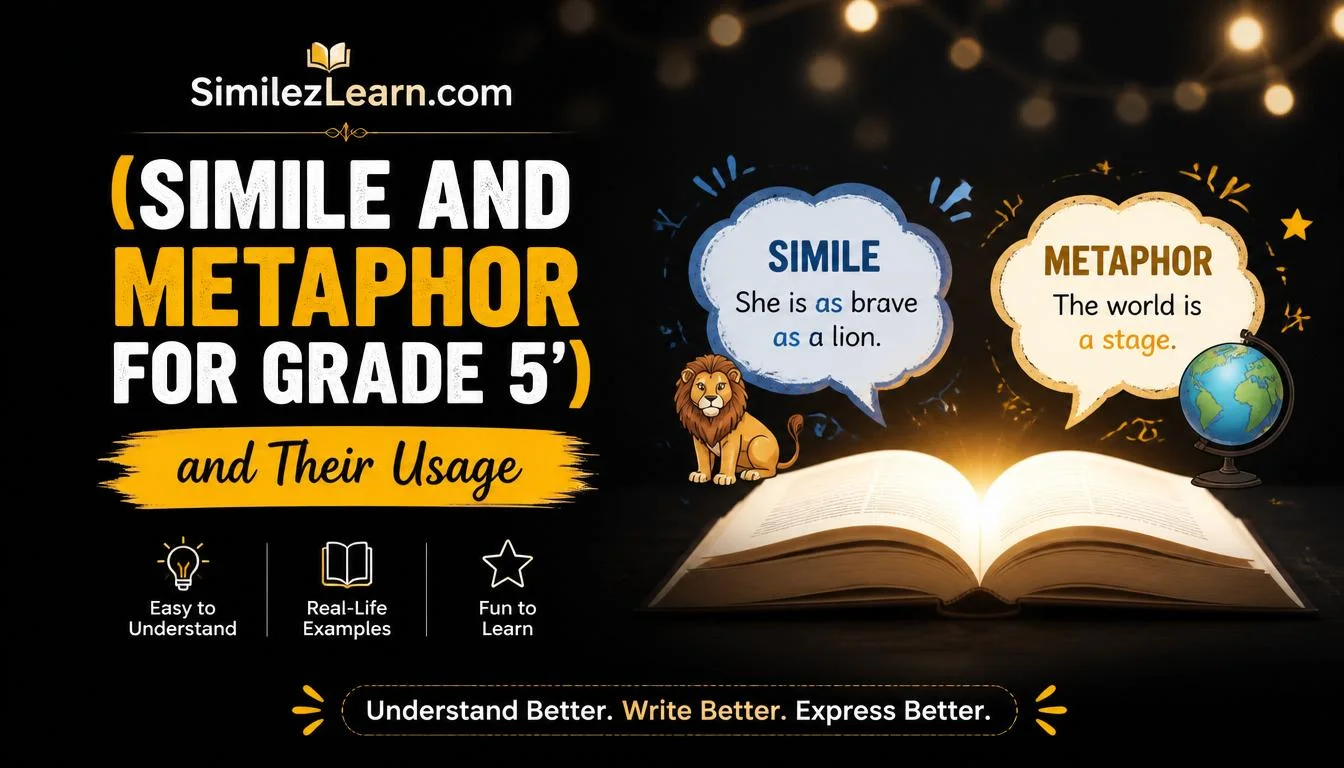
Learning figurative language is an exciting part of Grade 5 English. Two of the most important literary devices students learn are similes and metaphors. These tools make writing more colorful, creative, and interesting by helping readers imagine ideas more clearly.
For example, instead of saying, “The boy was fast,” you can write “The boy was as fast as a cheetah” (simile) or “The boy was a cheetah on the track” (metaphor). Both create stronger images than a simple sentence.
Whether students are writing stories, poems, essays, social media captions, or classroom assignments, understanding simile and metaphor for Grade 5 can greatly improve their communication skills. This guide explains everything in simple language and provides plenty of examples that are easy to understand.
Updated for 2026, this article is designed for students, teachers, parents, and anyone looking for a clear explanation of similes and metaphors.
What Is Simile and Metaphor for Grade 5?
What Is a Simile?
A simile compares two different things using the words like or as.
Example
“The clouds were like fluffy cotton.”
This comparison helps readers imagine soft, white clouds.
What Is a Metaphor?
A metaphor compares two things directly without using like or as.
Example
“The clouds were cotton in the sky.”
This directly compares clouds to cotton.
Why Are Similes and Metaphors Important?
They help students:
- Improve creative writing
- Build stronger descriptions
- Make stories more interesting
- Develop reading comprehension
- Understand figurative language
From real-life writing experience, students who learn similes and metaphors often become more confident writers because they can express ideas in creative ways.
How Simile and Metaphor for Grade 5 Works
Both literary devices compare things, but they do it differently.
Simile Formula
Thing + Like/As + Comparison
Example:
“The kitten was as soft as a pillow.”
Metaphor Formula
Thing = Comparison
Example:
“The kitten was a pillow of fur.”
The main purpose is to help readers visualize what the writer is describing.
Examples of Simile and Metaphor for Grade 5 in Everyday Life
In everyday conversations, people often use simile and metaphor for Grade 5 examples without realizing it.
At School
Simile:
“The classroom was as quiet as a mouse.”
Metaphor:
“The classroom was a library.”
During Sports
Simile:
“He ran like the wind.”
Metaphor:
“He was a rocket on the field.”
At Home
Simile:
“The blanket was as soft as a cloud.”
Metaphor:
“The blanket was a cloud.”
In Friendships
Simile:
“My friend is as loyal as a dog.”
Metaphor:
“My friend is a rock.”
40 Simile and Metaphor Examples for Grade 5
Simile Examples
1. As busy as a bee
Meaning: Very busy.
Example: Sarah was as busy as a bee preparing for the school fair.
2. As brave as a lion
Meaning: Very brave.
Example: Tom was as brave as a lion during the competition.
3. As fast as a cheetah
Meaning: Very fast.
Example: The runner was as fast as a cheetah.
4. As quiet as a mouse
Meaning: Very quiet.
Example: The classroom was as quiet as a mouse.
5. As bright as the sun
Meaning: Very bright.
Example: Her smile was as bright as the sun.
6. As light as a feather
7. As cold as ice
8. As soft as silk
9. As sweet as honey
10. As tall as a tree
11. Like a bird in the sky
12. Like a fish in water
13. Like a rocket launching
14. Like a rainbow after rain
15. Like a butterfly dancing
16. Like a kite in the wind
17. Like popcorn popping
18. Like a train speeding by
19. Like a flower blooming
20. Like sunshine on a summer day
Metaphor Examples
21. The classroom was a zoo
Meaning: Very noisy.
Example: The classroom was a zoo before the teacher arrived.
22. Time is a thief
Meaning: Time passes quickly.
Example: Time is a thief that steals our moments.
23. Her smile was sunshine
Meaning: Warm and cheerful.
Example: Her smile was sunshine on a cloudy day.
24. He is a rock
Meaning: Dependable.
Example: My brother is a rock during difficult times.
25. The world is a stage
Meaning: Life is like a performance.
Example: The world is a stage where everyone has a role.
26. The test was a mountain
27. The city was a jungle
28. His mind is a computer
29. Books are windows
30. The moon was a lamp
31. The classroom was an ocean
32. My teacher is a treasure
33. The playground was a battlefield
34. Ideas are seeds
35. Friendship is glue
36. The road was a ribbon
37. The stars were diamonds
38. Hope is a candle
39. The snow was a blanket
40. Life is a journey
Meaning & Example: Each metaphor creates a vivid image by making a direct comparison.
Famous or Popular Examples
Many famous books, poems, and songs use similes and metaphors such as:
Popular Similes
- As busy as a bee
- As brave as a lion
- As quiet as a mouse
- As light as a feather
- As cold as ice
Popular Metaphors
- Time is a thief
- Life is a journey
- The world is a stage
- Books are windows
- Hope is a candle
These examples are easy for Grade 5 students to understand and remember.
Simile and Metaphor for Grade 5 vs Related Concepts
| Concept | Definition | Example |
|---|---|---|
| Simile | Uses like or as | As fast as a cheetah |
| Metaphor | Direct comparison | He is a cheetah |
| Personification | Gives human traits | The wind danced |
| Hyperbole | Exaggeration | I have a million toys |
| Idiom | Phrase with special meaning | Hold your horses |
Key Difference
A simile uses like or as, while a metaphor compares things directly.
How to Use or Create Simile and Metaphor for Grade 5
Step 1: Choose Something to Describe
Examples:
- Friend
- Animal
- Weather
- School
- Sports
Step 2: Think of Similar Characteristics
Examples:
- Fast = cheetah
- Bright = sun
- Strong = lion
Step 3: Create a Simile
“The athlete was as fast as a cheetah.”
Step 4: Create a Metaphor
“The athlete was a cheetah on the track.”
Step 5: Keep It Simple
Grade 5 students should choose comparisons that are easy to understand.
Practical Uses of Simile and Metaphor for Grade 5
Essays
“The playground was a jungle of excitement.”
Poems
“The clouds were like cotton floating in the sky.”
Stories
“The dragon was a mountain of fire.”
Social Media Captions
- Bright as the sun.
- Life is a journey.
- Fast as a rocket.
Daily Conversation
“I’m as hungry as a bear.”
Common Mistakes People Make With Simile and Metaphor
Forgetting Like or As in Similes
❌ He was a lion.
✅ He was as brave as a lion.
Using Like or As in Metaphors
❌ Life is like a journey. (Simile)
✅ Life is a journey. (Metaphor)
Making Comparisons Too Complicated
Use examples children can understand.
Mixing Different Comparisons
Keep one clear comparison in each sentence.
Overusing Figurative Language
Too many comparisons can confuse readers.
Related Topics for Internal Linking
- Simile examples for kids
- Metaphor examples for students
- Figurative language guide
- Personification examples
- Hyperbole examples
- Idioms for Grade 5
- Creative writing activities
- Literary devices for children
Frequently Asked Questions
What is a simile for Grade 5?
A simile compares two things using like or as.
What is a metaphor for Grade 5?
A metaphor directly compares two things without using like or as.
Why do Grade 5 students learn similes and metaphors?
They improve writing, reading, and creativity.
What is an easy simile example?
“As fast as a cheetah.”
What is an easy metaphor example?
“Time is a thief.”
Conclusion
Understanding simile and metaphor for Grade 5 helps students become stronger readers and more creative writers. These literary devices allow children to describe people, places, emotions, and experiences in vivid and memorable ways.
Similes use like or as, while metaphors make direct comparisons. Both make writing more engaging and help readers create mental images.
Practice using similes and metaphors in essays, poems, stories, and everyday conversations. The more students experiment with figurative language, the more confident and creative they will become. Updated for 2026, this guide provides everything Grade 5 learners need to master these important literary devices.
DISCOVER MORE ARTICLES
Simile for Grade 3: Easy Examples and Meanings for Kids 2026
Simile for Keep: Meaning, Uses, and Practical Examples 2026
Simile for Painting: Meaning, Uses, and Writing Tips 2026
